


Tags : #Morocco #France #Laurent_Fabius #Moroccoleaks #Salaheddine_Mezouar #Hacker_Chris_Coleman
December 23, 2014
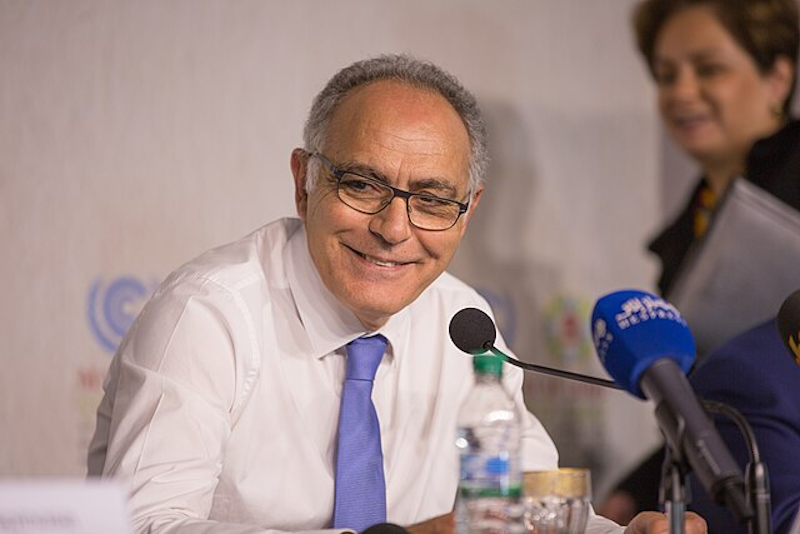
On March 28, 2014—as one learns while Googling the French and Moroccan Foreign Ministers in search of an official photo of them together—Laurent Fabius apologized to his counterpart, Salaheddine Mezouar, who had been subjected to a grueling airport screening at Roissy despite his rank and passport. This anecdote, while perhaps significant of the prejudices prevailing among French airport ground staff, serves here only to introduce a document posted online by a « source » via Twitter.

The source in question, calling themselves « Chris Coleman, » has already dropped numerous documents. They implicate French journalists, essentially accused of being paid for flattering articles about the Moroccan Kingdom—published alongside their official activities and employers by websites and publications with no readership—in exchange for reports, also favorable to the Kingdom, produced via their official employers and outlets which do have an audience. Translation: in exchange for a sympathetic report—particularly regarding the painful Sahrawi question—on a major TV channel or in a major newspaper, journalists are commissioned for a « tourist » article that no one will read, lost on the web or in some magazine meant to brighten institutional waiting rooms, but for which they will be paid far beyond any standard rate.
On the margins, so to speak, some of these documents establish links between Moroccan « spooks » (intelligence agents) and dignitaries, American diplomats, and pro-Israeli lobbyists… plenty of fodder for virtual debates.
If Coleman wanted people to think he was acting on orders from the Algerian services to destabilize and weaken Morocco—since Algeria is supposed to support the Polisario Front, the opponent of the Moroccans—he wouldn’t go about it any differently. Thus he plays his game, mixing authentic documents with others of doubtful origin. Verification is, in fact, sometimes impossible, as « metadata » can undergo « corrections. » A Word document or an email, for example, would be particularly easy to backdate.
Circulated on social networks, these documents have not failed to arouse much interest, sharing, and dispute. Journalists are ready to get emotional about these kinds of practices, but when it comes to denouncing their colleagues, they are surprisingly fond of evidence, cross-checking, and authentication…
The Web and its so-called social networks are swarming with tweets and shares regarding Coleman’s revelations. People reply to each other, challenge one another, and dig up « proof. » Citizens, trolls, activists, journalists. Consequently, Mediapart eventually looked into the matter (HERE, for subscribers). Sorting the wheat of verified info from the chaff of seductive rumors. Or more or less.
Because while this site allows a few journalists to effectively complete and distribute certain thorny investigations on a large scale, it also sometimes serves to « drown the fish »—to kill off a poisoning issue. One thinks here of the recent, surprising, murky, and poorly-supported article regarding the possibility that Pierre Péan might have tried to have the Gabonese government buy his silence. An article which, from « Françafrique » experience, could only serve to blow smoke, offer fake leads, and needlessly speculate on fundamental impossibilities: enough to possibly discredit Péan and thus diminish, folklorize, relativize, complicate, and therefore lose the point of his book on Ali [Bongo], the son of Omar, who leads the « Bongolian » emirate.
This time, Mediapart seems to be in good faith.
Except for this: why is information as important as what follows « lost » in the (faithful) review of a Coleman affair whose dimensions are primarily journalistic?
To put the question another way: why is such information not the subject of an article in itself? Here is how Mediapart presents one of the documents:
« In the case of the documents posted by Chris Coleman, some are indisputably authentic, and tend to prove that there was indeed a hack, due to the fact that they relate to known facts, such as the wedding photos of a minister or the passport of Foreign Minister Mezouar.
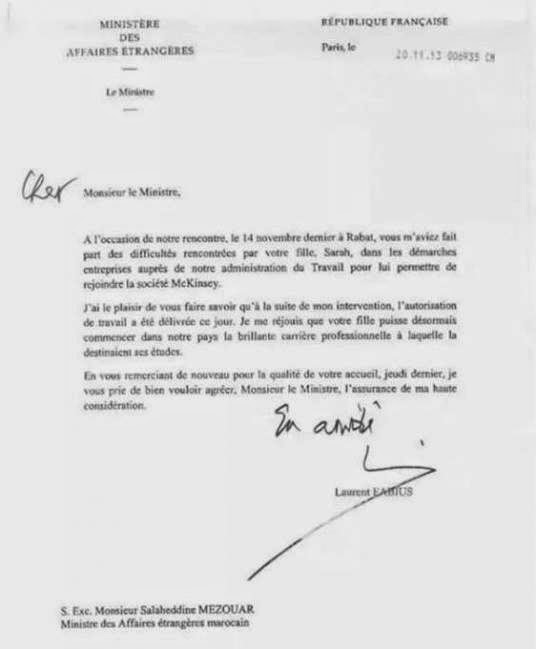
Other official documents are consistent in their metadata and appear authentic in their presentation. For example, Chris Coleman released two letters sent by Laurent Fabius to his Moroccan counterpart. In one, dated November 20, 2013, he explains that he intervened at his request with the labor administration to facilitate his daughter’s obtaining of a work permit in France. »
No one doubts that this practice—the « handout, » the fast-tracking of formalities—is widespread far beyond « Françafrique. » And Fabius and his Moroccan colleague are only the exposed fall guys of a generalized farce. What is surprising is that the « topplers of Cahuzac » [Mediapart] are trivializing—by burying it in a barely understandable affair—one of those documents with which they usually create a buzz.
Regarding the same French minister—whom web rumors claim is ill—we will take the liberty of suggesting another case to Mediapart, another interesting « fact. »
From what is being said, in 2013—the same year—the ICC was supposedly on the verge, for lack of evidence in the file, of releasing the last elected Ivorian president, Laurent Gbagbo. Upon learning this—let us not forget that [Alassane] Ouattara’s lawyer is close to Hollande (and to Mediapart)—Laurent Fabius, in full solidarity with previous French governments (and close to Mrs. Ouattara), reportedly hurried to take advantage of a trip to the Netherlands to stop by The Hague and ensure that the ICC ultimately kept Gbagbo in its jails.
Text / Louis Fall (feat G.P.)