The crisis surrounding Mr. Ross had negative repercussions on Moroccan-American relations, with the United States firmly supporting the UN Envoy. These tensions peaked in 2013 during the American attempt to expand the mandate of MINURSO to include the issue of human rights. A lull occurred after high-level telephone exchanges between King Mohammed VI, the UN Secretary-General, and President Barack Obama.
Tags: #Christopher_Ross #Special_Envoy #Western_Sahara #Morocco #United_States #Algeria #MINURSO #Human_Rights
The document analyzes the evolution of the role of Christopher Ross, Personal Envoy of the UN Secretary-General for Western Sahara since his appointment in 2009, as well as the diplomatic tensions he provoked between Morocco, the United Nations, and the United States.
After several rounds of negotiations launched from 2007, the political process stalled in 2012. Morocco then expressed strong reservations regarding Mr. Ross’s objectivity, approach, and respect for his mandate, going so far as to withdraw its confidence in him in May 2012, considering his actions biased and exceeding his mandate. This decision was rejected by the UN and by Washington.
The crisis surrounding Mr. Ross had negative repercussions on Moroccan-American relations, with the United States firmly supporting the UN Envoy. These tensions peaked in 2013 during the American attempt to expand the mandate of MINURSO to include the issue of human rights. A lull occurred after high-level telephone exchanges between King Mohammed VI, the UN Secretary-General, and President Barack Obama.
However, the text highlights signs of a new crisis with the American administration, linked to the United States’ desire to see Mr. Ross resume his activities in Morocco without the clarifications requested by the Kingdom regarding his approach being provided.
The document warns of the diplomatic consequences of this situation: Morocco’s image as responsible for blocking the political process, an unfavorable evolution of positions within the UN – notably the American attempt to absolve Algeria of its alleged responsibility in the conflict – and the possible exploitation of these tensions by Morocco’s adversaries.
Finally, the text recommends a strategic reassessment of the situation, including a proactive diplomatic approach to the permanent members of the Security Council and the possible challenge to the Personal Envoy’s mandate, in order to preserve Morocco’s interests on the Sahara issue and its relations with its key partners.
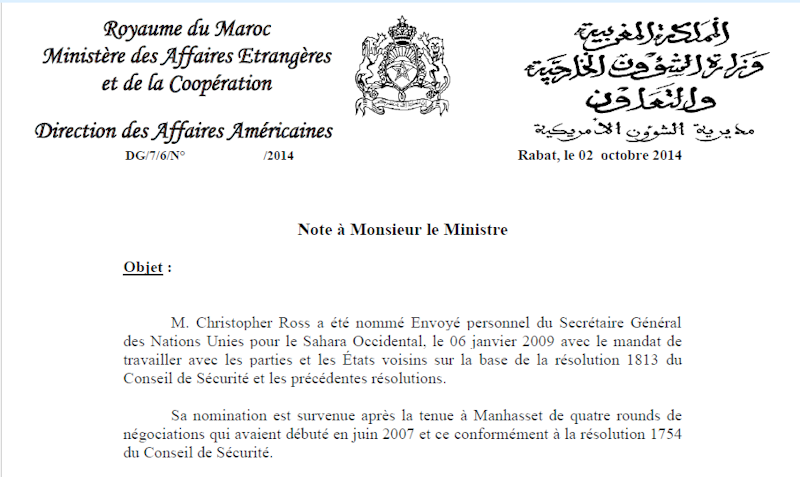
Text of the Note
Kingdom of Morocco
Ministry of Foreign Affairs
and Cooperation
Directorate of American Affairs
Ref: DG/7/6/N° … /2014
Rabat, October 02, 2014
Note to His Excellency the Minister
Mr. Christopher Ross was appointed Personal Envoy of the Secretary-General of the United Nations for Western Sahara on January 06, 2009, with a mandate to work with the parties and neighboring states based on Security Council Resolution 1813 and previous resolutions.
His appointment followed the holding of four rounds of negotiations in Manhasset which began in June 2007, in accordance with Security Council Resolution 1754.
After making two visits to Morocco, Mr. Ross launched informal negotiation meetings. However, after nine rounds, the last of which was held in March 2012, the process stalled in the absence of any prospect of progress.
Tensions between the Moroccan authorities and the Personal Envoy of the Secretary-General intensified around the beginning of 2012, with Morocco having previously expressed, on several occasions, serious concerns regarding the integrity of the Personal Envoy’s mandate, the relevance of his approach, and the objectivity of his conduct.
Following the Secretary-General’s report on the Sahara in April 2012, the Kingdom decided on May 17, 2012, to withdraw its confidence from Mr. Ross, describing his work as « partial and unbalanced. » This decision, let us remember, was refuted by both the UN Secretary-General and Washington.
At this level, the Moroccan authorities considered that Mr. Ross, having been unable to achieve political progress, allowed himself to become involved in matters that are not part of the mandate entrusted to him by the UN Secretary-General.
However, Morocco’s concerns regarding Mr. Ross’s approach were not, at the time, taken into account by the American side, which felt personally targeted by our country’s position and strongly supported his « return. »
Indeed, during the tensions that arose in January 2012, following statements by Mr. Christopher Ross blaming Morocco for the postponement of his visit – initially scheduled for May 2012 – to June, the American Embassy in Rabat expressed the concerns of some officials in Washington who considered that through this attitude, « Morocco was against the United States » and that it was « deliberately blocking Mr. Ross’s visit. »
The controversy surrounding the Personal Envoy of the UN Secretary-General had direct repercussions on relations between Morocco and the United States, with Washington having a particular sensitivity to anything concerning this American diplomat whose long career within the Department of State focused primarily on Middle Eastern and North African affairs. It should be recalled that he was U.S. Ambassador to Syria and Algeria, then Senior Advisor to the U.S. Mission to the United Nations for Middle Eastern and North African affairs. He also contributed to coordinating U.S. diplomacy in the Arab-Muslim world from 2001 to 2003.
The differences between Morocco and the United States on this issue reached their peak within the Security Council in April 2013, with Washington’s attempt, narrowly countered by Morocco, to expand the mandate of MINURSO to include the issue of Human Rights.
At the UN level, the crisis triggered around Mr. Christopher Ross was overcome following the telephone conversation on August 25, 2012, between His Majesty King Mohammed VI, may God assist him, and Mr. Ban Ki-Moon, UN Secretary-General, which allowed for the reframing of the UN mediation and the relaunching of the political process. This telephone conversation also facilitated the « return » of Mr. Ross, who was granted a Royal Audience on October 29, 2012.
At the level of Moroccan-American relations, the repercussions of the crisis lasted until May 9, 2013, when a telephone conversation between His Majesty King Mohammed VI, may God assist him, and President Barack Obama allowed tensions to be overcome and prepared the ground for the Royal visit to Washington in November 2013.
However, the beginnings of a second crisis with the Obama Administration are already beginning to emerge and once again concern Mr. Ross’s approach as well as his visit to Morocco.
Thus, the American Ambassador in Rabat expressed during a meeting held with His Excellency the Minister on July 31 last in this Department, questions about the « capacity » of the Special Envoy of the UN Secretary-General, Mr. Christopher Ross, « to undertake a new visit to Morocco and ensure that he can play his role, » while specifying that he « was not acting as his spokesperson. »
This American position, namely that Mr. Ross « must return » and that « Morocco must let him do his work, » was reiterated by Under Secretary of State Anne Patterson during a telephone conversation with Her Excellency the Delegate Minister, as well as by Under Secretary of State for Political Affairs Wendy Sherman, on the sidelines of the 69th session of the UN General Assembly.
Morocco’s position has been clearly stated and focuses essentially on the Kingdom’s right to obtain clarifications on the Personal Envoy’s approach and the need for his actions to conform to his mandate and the mission assigned to him.
Indeed, first, Morocco has not received a response to three questions concerning Mr. Ross’s mission, a response that was to be provided within 48 hours and is still awaited since last June 18. Second, he prefers to go through other channels rather than provide clear and direct answers. Finally, his statements as well as his report do not reflect the conclusions as presented to Moroccan officials during his visit to the Kingdom.
It should be noted, in this regard, that Mr. Ross’s last visit to Morocco was not publicized by the Kingdom, and he was also not received in a Royal Audience.
The overall situation is alarming, raises several questions, and foreshadows difficult periods both within the United Nations and with our American partners.
Indeed, our country is presented by Mr. Ross as responsible for the ongoing blockage in the political process, an idea circulated in the corridors of the United Nations and among the permanent members of the Security Council. It would therefore be wise, to assess our support, to plan an explanatory and anticipatory approach to the latter, paying particular attention to China and Russia, given that relations with France are currently tense and that Great Britain will likely align with the position of the United States, which provides unconditional support to Mr. Ross.
Regarding the consequences of this crisis on relations with the Obama Administration, a difficult period can be expected. Certainly, the period from late 2013 to 2014 saw a clear evolution in these relations with a busy and promising bilateral agenda. However, we must not underestimate our adversaries’ maneuvering abilities to take advantage of the ongoing tensions, especially since the Algerian Minister of Foreign Affairs, Mr. Ramtane Lamamra, visited Washington from September 18 to 20, 2014, where he was received by Secretary of State John Kerry and National Security Advisor Ms. Susan Rice.
It should be noted, at this level, that Washington has already begun to introduce changes in its position within the UN. Indeed, during the examination of the Security Council’s annual report to the General Assembly for the period August 1, 2013, to July 31, 2014, the American delegation introduced amendments to the part on the Sahara in said report by removing any reference to « neighboring states, » which would amount to completely absolving Algeria of its responsibility in the conflict surrounding our National Cause.
Therefore, at this stage, it would be necessary to assess the overall situation and gauge the political price of upcoming events, possibly considering the possibility for our country to disavow the current Personal Envoy of the Secretary-General as Algeria did in its time with his predecessor, Mr. Van Walsum, given the repeated tensions he provokes, which affect the evolution of Our National Cause within the Security Council and which impact our relations with one of our most important partners.
Tags: Christopher Ross Special Envoy Western Sahara Morocco United States Algeria MINURSO human rights