Tags: #Western_Sahara #Polisario_Front #Morocco #Antonio_Panzeri #European_Parliament #Qatargate #Moroccogate #Marocleaks
The confidential Moroccan diplomatic documents revealed between 2014 and 2015 by the hacker Chris Coleman were decisive in accusing the former Italian MEP Antonio Panzeri. At the time, he chaired the Maghreb Committee of the European Parliament.
In an « urgent » note from October 2011 sent by the Moroccan Mission to the European Union in Rabat, it is stated that « on the sidelines of the Parliament’s plenary session in Strasbourg, » at least one representative of the Mission had an « informal interview » with Mr. Panzeri’s advisor, who carried a message « for the attention of the Moroccan authorities. »
The purpose of this note is to prepare for the visit that S&D MEP Panzeri—then president of the EP’s Maghreb delegation—was to make to Morocco two weeks later. A delicate stop in Tindouf, where the Sahrawi refugee camps are located, was planned. This was a necessary step to preserve the MEP’s image of neutrality: « The visit to Tindouf is essential to consolidate Mr. Panzeri’s credibility with Algeria and the Polisario, after the latter accused him of being pro-Moroccan. » The Polisario Front is fighting for the independence of Western Sahara.
In short, everyone agreed: « it is not in Morocco’s interest for Mr. Panzeri to be perceived as such (pro-Moroccan). » Maintaining good relations with both the Algerians and the Moroccans, an accomplished politician capable of asserting « a long-term political agenda, carried out (…) always with tact and mastery, » Antonio Panzeri, the diplomatic note warns, « can be a weighty ally or a formidable adversary. »
FULL TEXT OF THE DOCUMENT
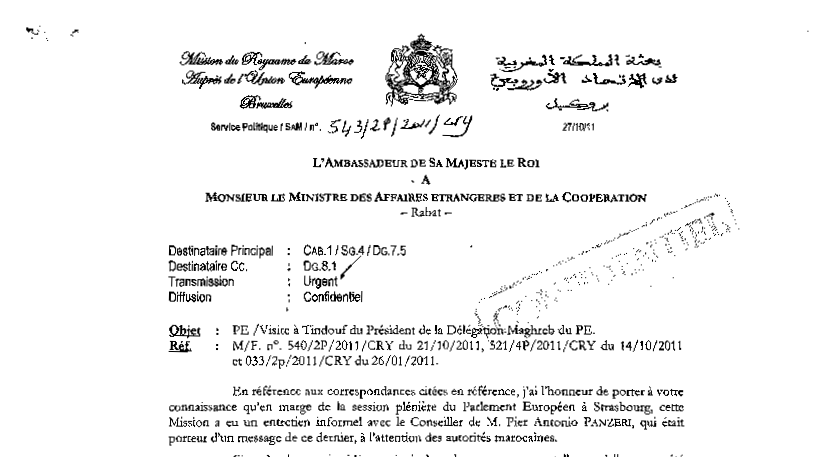
Mission of the Kingdom of Morocco to the European Union – Brussels Political Service SAM / n. 543/2P/2011/CRY THE AMBASSADOR OF HIS MAJESTY THE KING
TO: THE MINISTER OF FOREIGN AFFAIRS AND COOPERATION – Rabat Date: 27/10/11
In reference to the correspondence cited, I have the honor to inform you that on the sidelines of the plenary session of the European Parliament in Strasbourg, this Mission had an informal interview with the Advisor to Mr. Pier Antonio PANZERI, who carried a message from the latter for the attention of the Moroccan authorities.
The following are the three main ideas of this message as communicated:
- The visit to Tindouf is essential to consolidate Mr. PANZERI’s credibility with Algeria and the Polisario, after the latter accused him of being pro-Moroccan.
- It is not in Morocco’s interest for Mr. PANZERI to be perceived as such.
- PANZERI did his best to avoid the date of November 6.
- The date of the visit (November 7) is a reasonable compromise, in the sense that visiting the camps as a continuation of a visit to Algeria is symbolic in itself and constitutes, in any case, a better option (for Morocco) than an ad hoc visit to the camps.
- Mr. PANZERI begins his exchanges with Algerian and Polisario officials based on the position of the JPC (Joint Parliamentary Committee), which has always placed the Sahara issue within the framework of advanced regionalization.
- Nevertheless, Mr. PANZERI intends neither to mention autonomy with the Polisario nor to make a statement to that effect during his visit. He indicated that he would settle for listening to his interlocutors.
There is a strong demand in the EP regarding the Sahara issue. This issue is regularly raised by MEPs and heavily exploited by pro-Polisario elements, who exert significant pressure (notably within the S&D). The best way to manage this pressure is to confine it within the framework of the AFET (Foreign Affairs Committee) and to channel it through Mr. PANZERI, who is in a position to be a credible interlocutor for all parties.
At first glance, Mr. PANZERI’s message is intended to be reassuring. He is very aware of the sensitivity of his visit to the Tindouf camps and is making a significant effort to justify himself and not permanently compromise his access to Morocco. He seems to take seriously the recommendation not to visit the area east of the defense structure and promises to keep the Mission informed of the progress of his program in Tindouf.
From a dynamic point of view, recent developments should be seen as an extension of the methodical work begun by Mr. PANZERI since the first months following his election as head of the Maghreb Delegation. His contacts with the Polisario (today crowned by the visit), contacts with the Algerian authorities, the bridges of trust he has built with his Moroccan interlocutors, and, above all, the « constructive ambiguity » with which he has surrounded his attitudes, are manifestations of a long-term political agenda. It is difficult not to see in this a subliminal demonstration of a « nuisance capacity, » showing to what extent he can be a weighty ally or a formidable adversary.
Far from being a communication operation, the visit to Tindouf is a tactical milestone in the personal agenda of the President of D-MAG. Indeed, Mr. PANZERI plans to launch a « process » in the EP in which the Sahara issue would be the subject of regular and institutionalized debate within the AFET Committee.
These announcements were made by the President of the D-MAG (Maghreb Delegation) to general surprise, including that of MEPs who were part of the EP delegation to the 11th session of the inter-parliamentary dialogue with Algeria. There is reason to believe that they are, in large part, the result of discussions he had with Polisario representatives and Algerian officials.
Furthermore, the President of the D-MAG also announced his support for the establishment of a permanent structure for EU-Algeria parliamentary dialogue, modeled on the EU-Morocco Joint Parliamentary Committee (JPC), even though he had firmly opposed this idea only a few months prior, arguing that a JPC is the corollary of « Advanced Status » with the EU.
Similarly, Mr. PANZERI proposes to commemorate the fiftieth anniversary of Algeria’s independence by organizing a photography exhibition on Algeria within the EP.
At my request, an interview is scheduled with Mr. PANZERI on November 24, 2011. I would be grateful for any guidance you might provide in perspective of this meeting.
Ambassador Menouar ALEM
——————-
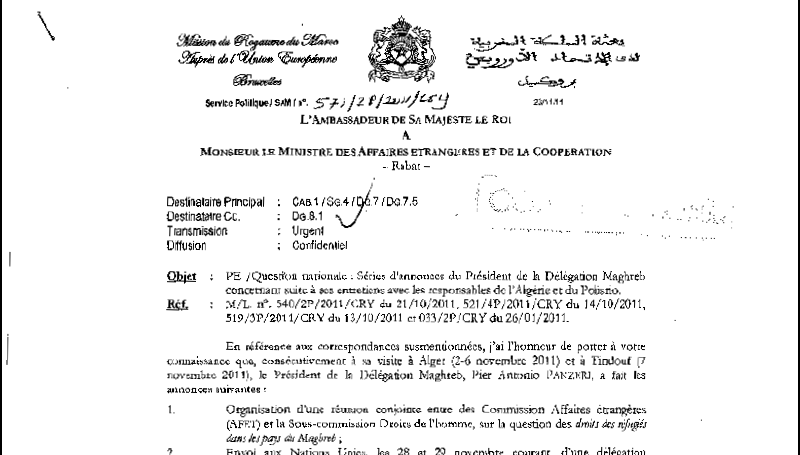
Announcements Made Following the Visit to Tindouf
One month later, Panzeri made a series of announcements summarized in the following report from Ambassador Mohamed Alem:
Mission of the Kingdom of Morocco to the European Union – Brussels Political Service / SAM n° 571/28/2011/ THE AMBASSADOR OF HIS MAJESTY THE KING
TO: THE MINISTER OF FOREIGN AFFAIRS AND COOPERATION – Rabat
Subject: EP/National Question: Series of announcements by the President of the Maghreb Delegation following his talks with Algerian and Polisario officials. Ref: [Correspondence codes listed in original text]
With reference to the aforementioned correspondence, I have the honor to inform you that, following his visit to Algiers (November 2-6, 2011) and Tindouf (November 7, 2011), the President of the Maghreb Delegation, Pier Antonio PANZERI, made the following announcements:
- Organization of a joint meeting between the Committee on Foreign Affairs (AFET) and the Subcommittee on Human Rights regarding the rights of refugees in Maghreb countries.
- Dispatching a delegation to the United Nations on November 28 and 29, representing AFET, the Committee on Development, and the Subcommittee on Human Rights, to draw attention to the concerning situation of Sahrawi refugees and the use of European humanitarian aid.
- Expression of a wish for the Polisario to be invited to speak at the European Parliament during a joint meeting of AFET and the Maghreb Delegation.
- Proposal to renew the invitation to the Secretary-General’s Personal Envoy, Mr. Christopher Ross, to participate in one of the aforementioned joint meetings.
- Announcement of a verbal invitation from the Polisario to the European Parliament to dispatch an ad hoc delegation of MEPs to assess the situation in the Tindouf camps.
- Proposal for a joint AFET / Subcommittee on Security and Defense meeting on counter-terrorism and regional cooperation between Algeria, Mauritania, and Niger, and the EU’s involvement in this cooperation. This follows discussions between Mr. PANZERI and the Algerian Minister Delegate for African and Maghreb Affairs.
- Organization of two Maghreb Delegation meetings dedicated to Maghreb integration: one with representatives of Moroccan, Tunisian, and Algerian employers’ organizations and trade unions, and the other with youth representatives from these three countries.
These announcements were made by the President of the D-MAG to general surprise, including that of MEPs who were part of the EP delegation to the 11th session of the inter-parliamentary dialogue with Algeria. There is reason to believe that they are, in large part, the result of discussions he had with Polisario representatives and Algerian officials.
Furthermore, the President of the D-MAG also announced his support for the establishment of a permanent structure for EU-Algeria parliamentary dialogue, modeled on the EU-Morocco Joint Parliamentary Committee (JPC), even though he had firmly opposed this idea only a few months prior, arguing that a JPC is the corollary of « Advanced Status » with the EU.
Similarly, Mr. PANZERI proposes to commemorate the fiftieth anniversary of Algeria’s independence by organizing a photography exhibition on Algeria within the EP.
At my request, an interview is scheduled with Mr. PANZERI on November 24, 2011. I would be grateful for any instructions you might provide in view of this meeting.
Ambassador Menouar ALEM
The Mission to Thwart the Tannock Project
In another cable—this one from January 2013—the Moroccan Mission to the EU submitted a roadmap to its government to promote « Morocco’s interests within the European Parliament in 2013. » This battle plan, involving the organization of debates, seminars, and guided tours, aimed to « thwart the growing activism of our adversaries within the EP. » Specifically, it aimed to keep an eye on the report that British MEP Charles Tannock, « known for his pro-Polisario positions, » was to draft regarding the human rights situation in Western Sahara. Several strategies were proposed, but the Mission intended to « coordinate its action with the President of the Maghreb Delegation to the EP, Mr. Antonio Panzeri, a close friend of Morocco, in order to reduce the potential for harm posed by the Tannock project. »
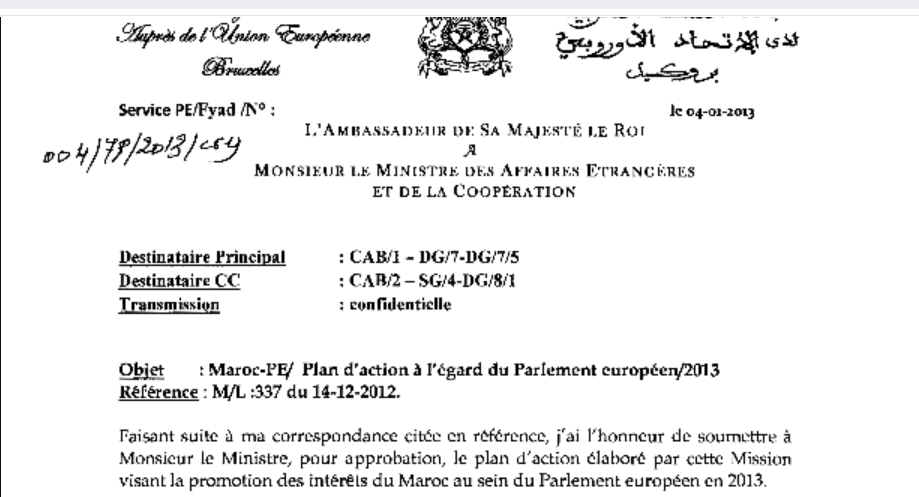
Sender: Ambassador of His Majesty the King
To: Minister of Foreign Affairs and Cooperation
Transmission: Confidential
Subject: Morocco-EP/ Action Plan regarding the European Parliament/2013
I have the honor to submit for approval the action plan aimed at promoting Morocco’s interests within the European Parliament in 2013. The objective is to counteract the growing activism of our adversaries.
This action plan is broken down as follows:
- Seminar on Advanced Regionalization in Morocco: Capitalizing on the regional development model for the Southern Provinces. Mr. Antonio Panzeri has welcomed this initiative and assured us of his support.
- Exchange of views on Human Rights in Morocco: Inviting the President of the CNDH (National Human Rights Council) to the EP to discuss achievements in the Southern Provinces.
- Training internship for Moroccan parliamentarians at the EP: To deepen inter-parliamentary cooperation.
- Study visit to Morocco by the EU-Morocco Friendship Group: Proposed for Jan 31 – Feb 4, 2013, with a focus on media impact in the Southern Provinces.
- Restructuring the EU-Morocco Friendship Group: The Mission notes dysfunctions under current leadership and advocates for regular meetings, a quarterly newsletter, and recruiting active members from major EU states and Nordic countries.
- Draft report on human rights in « Western Sahara and the Sahel »: To counter British MEP Charles Tannock (ECR Group, pro-Polisario).
- Actions include: Keeping Mr. Tannock informed of socio-economic achievements and security in the Maghreb, and utilizing official, parliamentary, and associative channels.
- Coordination with Mr. Antonio Panzeri to reduce the negative impact of the Tannock project.
- Strengthening Parliamentary Action:
- Joint Parliamentary Committee (JPC): Utilizing meetings in Brussels for lobbying.
- Parliamentary Diplomacy: Creating an EU-Morocco friendship group within the Moroccan Parliament, mobilizing in regional forums (NATO, OSCE, UfM), and linking Moroccan political parties with EP political groups.
- National Coordination: Creating a « monitoring cell » (cellule de veille) and designating French and English-speaking parliamentarians for long-term follow-up.
- Lobbying Agency: Creating an agency to strengthen Moroccan influence within EU institutions.
- Parliamentary Coalition: Establishing a pressure network of European and Moroccan parliamentarians.
Signature: Ambassador Menouar ALEM