


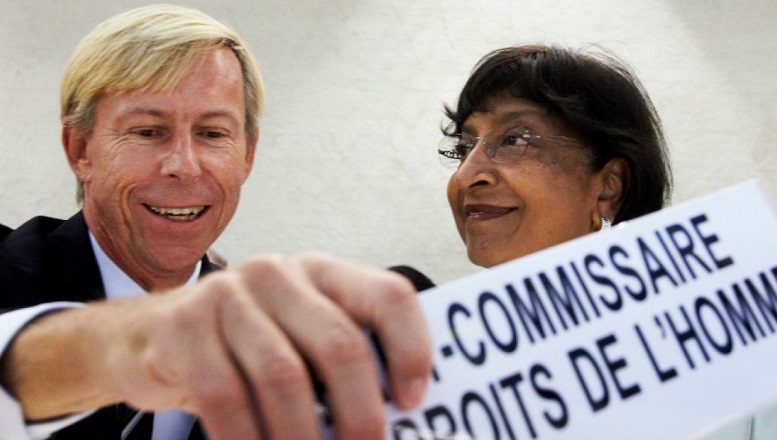
#WesternSahara #Morocco #Polisario #OHCHR #UNHCR #NaviPillay #AndersKompass #Omar Hilale
At the UN Human Rights Office in Geneva, where Swedish national Anders Kompass served as Head of Field Operations for many years, practically nothing was accomplished for the human rights of the Sahrawis. Moroccan lobbying and pressure prevented it.
Swedish radio, television, and newspapers praised Anders Kompass as a courageous whistleblower for his civil bravery when he provided direct information to France about sexual abuses committed by French UN soldiers against children in the Central African Republic. Someone within the office leaked the information to the British newspaper The Guardian, and the story became a global headline. Later, Kompass was cleared of professional misconduct suspicions, but he chose to leave his position at the UN Human Rights Office. He now works at the Ministry of Foreign Affairs in Stockholm. Subsequently, he was appointed interim director of the Human Rights Institute. He has a long international career with senior positions at the UN and the Ministry of Foreign Affairs. Specifically, he was Head of the External Affairs Department at the UN High Commissioner for Human Rights (OHCHR) in Geneva and represented the OHCHR in Colombia, Guatemala, and Mexico. He also served as Sweden’s ambassador to Guatemala between 2017 and 2020.

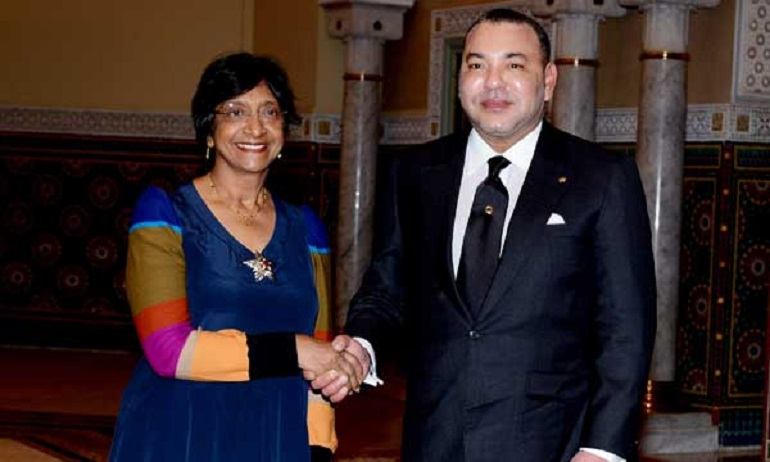
In 2014, French hacker Chris Coleman leaked confidential diplomatic correspondences on Twitter from Morocco’s ambassador in Geneva, Omar Hilale, addressed to the Moroccan Ministry of Foreign Affairs. These letters revealed how Anders Kompass acted to discourage High Commissioner Navi Pillay from visiting Western Sahara in 2014. He ensured that the OHCHR’s contribution to the UN Secretary-General’s report on Western Sahara was favorable to Morocco. He pressured Pillay to avoid making “concessions” to the late President of the Sahrawi Arab Democratic Republic, Mohamed Abdelaziz, during their meeting in Geneva on May 23, 2013. Kompass insisted that a technical mission be set up in Western Sahara in May 2014, led by himself instead of the OHCHR Representative in New York, who was considered hostile to Morocco.
Morocco secured the Human Rights Commissioner’s silence thanks to an annual contribution of one million dollars.

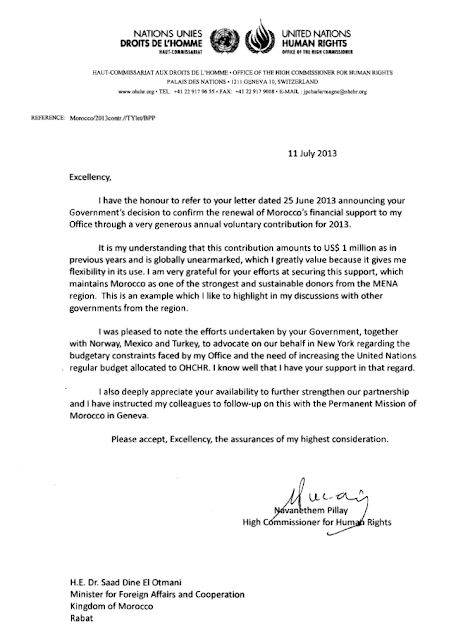
In a letter dated July 11, 2013, Navi Pillay addressed Saadeddine El Othmani, then Morocco’s Foreign Minister, thanking the Moroccan government for renewing its voluntary annual contribution of $1 million for 2013. She emphasized the importance of the funds not being earmarked for a specific project, providing her office with greater flexibility in their use.
Morocco is presented as one of the most significant and consistent donors in the Middle East and North Africa region.
The letter also commends Morocco’s diplomatic efforts (alongside Norway, Mexico, and Turkey) to advocate in New York for an increase in the regular UN budget allocated to the High Commissioner.
Finally, it expresses the desire to strengthen the partnership between the institution and Morocco’s permanent mission in Geneva.

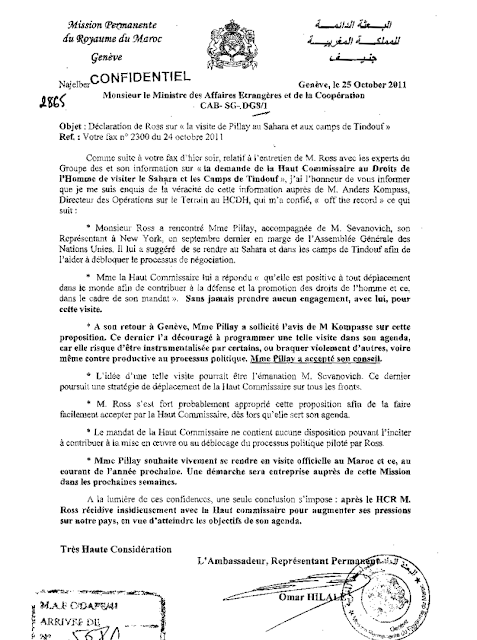
On October 25, 2011, a document detailed the diplomatic maneuvers surrounding a proposed visit by High Commissioner Pillay to Western Sahara and the refugee camps in Tindouf.
- Christopher Ross suggested this visit to Pillay in September 2011, asserting that it could help unblock political negotiations.
- Although she expressed initial approval for a visit within her mandate, she made no concrete commitment to Ross.
- After consulting Pillay, Anders Kompass formally discouraged her from undertaking the trip, warning of the risks of political exploitation and counterproductive effects on the political process. Pillay accepted this advice.
- Ambassador Hilale concluded that Ross was using UN agencies (OHCHR, UNHCR) to increase pressure on Morocco and serve his own agenda.
- Instead of a visit to Western Sahara, Pillay expressed a desire to make an official visit to Morocco in 2012.
- UN Envoy Christopher Ross visits to Western Sahara
UN Envoy Christopher Ross visits to Geneva

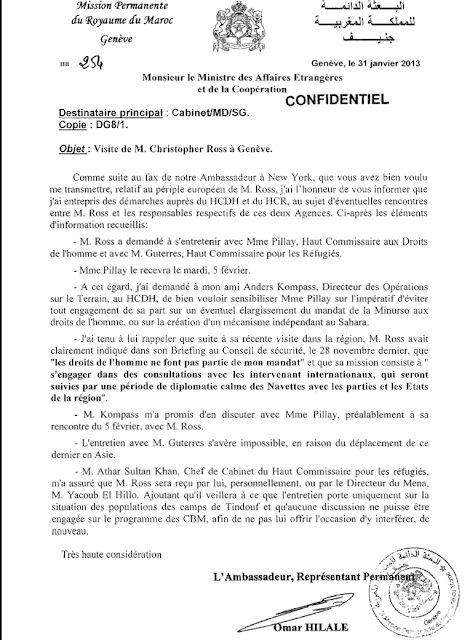
The confidential diplomatic note dated January 31, 2013, sent by Omar Hilale to Morocco’s Foreign Minister, detailed Moroccan efforts to limit Christopher Ross’s contacts with UN agencies and prevent human rights issues from being integrated into his mandate.
Meeting with OHCHR:
- Ross was scheduled to meet Pillay on February 5.
- The ambassador used an internal contact (Anders Kompass) to influence Pillay not to raise the expansion of MINURSO’s mandate to human rights.
- The justification was that Ross himself declared that human rights were not part of his mandate.
Meeting with UNHCR:
- A meeting with Commissioner Guterres was impossible due to travel.
- Ross would meet his Chief of Staff or the Director for the MENA region.
- The discussions would be limited to the situation in Tindouf camps and would not address the Confidence-Building Measures (CBM) to reduce Ross’s interference.

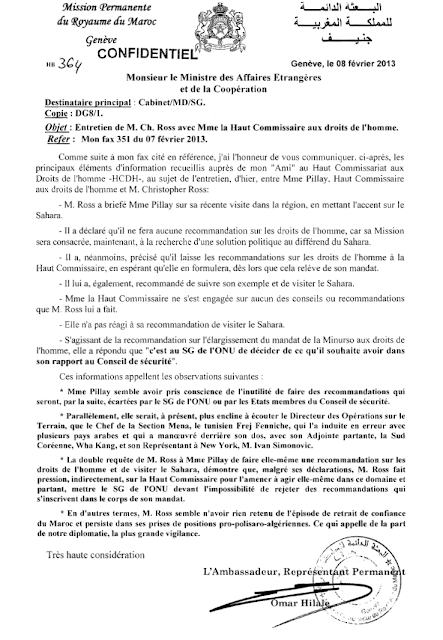
The document dated February 8, 2013, recorded a meeting between Christopher Ross and Pillay. Ross stated he would not make direct recommendations on human rights to focus on the political solution, but encouraged Pillay to formulate them herself and visit Western Sahara. Pillay remained reserved, deferring responsibility to the UN Secretary-General. Omar Hilale interpreted Ross’s approach as indirect pressure through the OHCHR. The document also highlighted internal power struggles and Ross’s “pro-Polisario/Algerian” stance, and Moroccan officials worked to limit the influence of any visits by President Mohamed Abdelaziz.
Visit of the Sahrawi President to Geneva
On another occasion, their meeting was devoted to the visit that the Sahrawi President, Mohamed Abdelaziz, was to make in May 2013 to the Council to meet with Navanethem Pillay. In both cases, the Ambassador and his two friends manoeuvered to limit the impact of these two visits and influenced Pillay so that she would not react in a way that would harm Morocco’s interests.

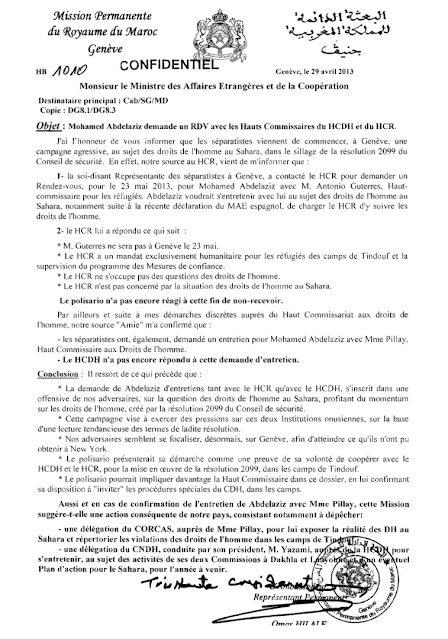
This document, dated April 29, 2013, informs the Moroccan Ministry of Foreign Affairs of the launch, in Geneva, of a campaign led by separatists aimed at internationalizing the issue of human rights in the Sahara, in the context of Security Council Resolution 2099. Mohamed Abdelaziz requested meetings with the Office of the United Nations High Commissioner for Refugees (UNHCR) and the Office of the High Commissioner for Human Rights (OHCHR) to discuss the human rights situation in the Sahara.
The UNHCR rejected the request, reiterating that its mandate is strictly humanitarian, limited to refugees in the Tindouf camps and confidence-building measures, and that it does not address human rights issues or the situation in the Sahara. The OHCHR, however, has not yet responded to the request for a meeting.
The document concludes that this initiative is part of an offensive strategy by Morocco’s adversaries to exert pressure on UN institutions, relying on a biased interpretation of Resolution 2099 and refocusing their efforts on Geneva after a setback in New York. It is also believed that the Polisario Front is seeking to portray itself as cooperative with UN human rights mechanisms.
In response, the Permanent Mission of Morocco recommends, should a meeting with the OHCHR be confirmed, sending delegations from CORCAS and the CNDH to Geneva to present Morocco’s position, outline the human rights situation in the Sahara, and draw attention to the violations committed in the Tindouf camps.
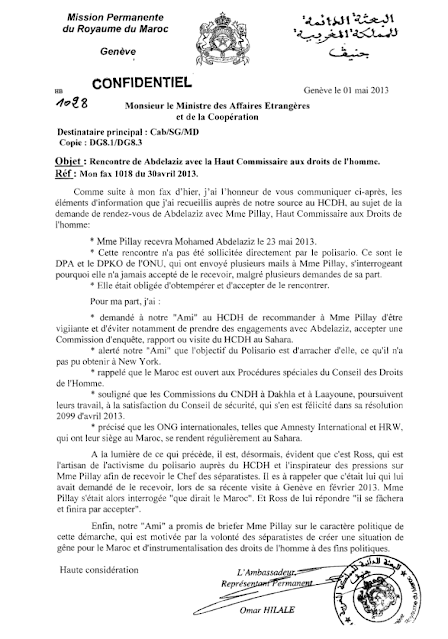
The document, dated May 1, 2013, informs the Moroccan Ministry of Foreign Affairs that Ms. Navi Pillay, High Commissioner for Human Rights, will receive Mohamed Abdelaziz on May 23, 2013. This meeting was not directly requested by the Polisario Front, but resulted from pressure exerted by the UN Department of Political Affairs (DPA) and the Department of Peacekeeping Operations (DPKO), which urged Ms. Pillay to accept the meeting.
In light of this situation, the Permanent Mission of Morocco contacted its representatives at the Office of the High Commissioner for Human Rights (OHCHR) to advise Ms. Pillay to remain vigilant and avoid any political involvement, any commission of inquiry, or any OHCHR visit to the Sahara. Morocco also reiterates its openness to the special procedures of the Human Rights Council and highlights the work of the National Human Rights Council (CNDH) commissions in Dakhla and Laayoune, as well as the regular access of international NGOs to the Sahara.
The document concludes that this activism is orchestrated by Christopher Ross, presented as the instigator of the pressure exerted on behalf of the Polisario Front, and reiterates that the separatists’ objective is to obtain in Geneva what they failed to achieve in New York, by exploiting the issue of human rights for political ends. Finally, the Mission indicates that its contacts at the Office of the High Commissioner for Human Rights (OHCHR) have committed to informing Ms. Pillay of the political and strategic nature of this approach.
Anders Kompass and Omar Hilale acted to dissuade Ms. Pillay from undertaking a visit to Western Sahara in 2014.


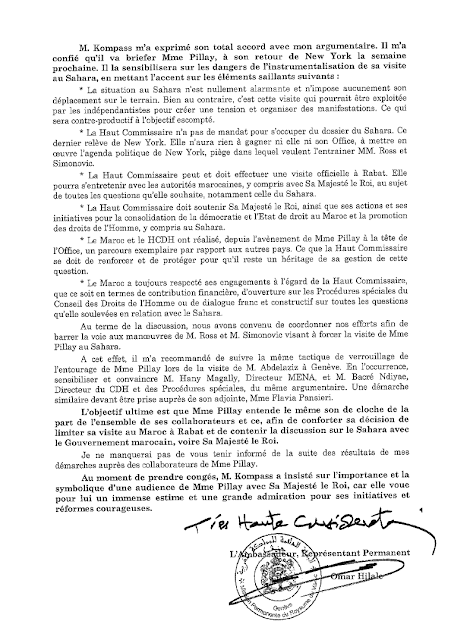
This document, dated October 3, 2013, concerns the planned visit of the High Commissioner for Human Rights to Western Sahara, which, according to Omar Hilale, is being pressured by Christopher Ross, supported by Ivan Simonovic (OHCHR representative in New York) and the Department of Political Affairs (DPA), to visit the occupied territories.
Faced with resistance, Mr. Simonovic suggested dividing the mission: Ms. Pillay would go to Rabat, while he himself would conduct the visit to Western Sahara and the Tindouf camps.
Morocco has stated its willingness to receive Ms. Pillay for an official visit to Rabat but firmly opposes any extension of this trip to Western Sahara. Morocco points out that during her 2012 visit to Algeria, Ms. Pillay did not visit the Tindouf camps.
The ambassador asserts that the High Commissioner is not mandated to deal specifically with the Western Sahara issue. Morocco reiterates that it already cooperates extensively with UN special procedures and that Western Sahara is already accessible to officials and the press.
According to Hilale, Morocco fears that this visit will be exploited by Christopher Ross to further his political agenda. He believes such a visit, perceived as a manipulation, could jeopardize the relationship of trust established between Morocco and the Office of the High Commissioner.
Anders Kompass pledges to brief Ms. Pillay to dissuade her from traveling to Western Sahara, arguing that such a visit would be exploited by separatists and would provoke unnecessary tensions.
The argument rests on the fact that the Western Sahara issue falls under the political competence of the UN in New York and not within the mandate of the High Commissioner in Geneva.
Morocco favors a limited official visit to Rabat, including an audience with the King, in order to highlight the country’s democratic reforms rather than the territorial conflict.
Ambassador Omar Hilale and Kompass agree to « lock down » Ms. Pillay’s entourage by convincing her key collaborators (notably directors Hany Magally and Bacré Ndiaye) to adopt the same narrative. The ultimate goal is for the High Commissioner to hear only one « speech » from her staff, thus reinforcing her decision to limit her trip to Morocco and remove the Sahara issue from her agenda.
This latter document, dated October 9, 2013, details the continuation of the strategy to « lock down » the entourage of the High Commissioner for Human Rights (OHCHR) in order to counter UN pressure from New York.
Interview with Bacré Ndiaye: Ambassador Omar Hilale met with Mr. Ndiaye, Director of Special Procedures at the Office of the High Commissioner for Human Rights (OHCHR), to persuade him to support Morocco’s position.
Mr. Ndiaye maintains that the absence of a visit to the Tindouf camps during Ms. Pillay’s trip to Algeria (2012) justifies, for the sake of consistency and legitimacy, the refusal of a visit to the Sahara. He emphasizes that no request was ever made by officials in New York to include Tindouf in the itineraries of visits to Algeria.
He believes that a successful visit to Rabat would allow Ms. Pillay to end her mandate on a positive note with a cooperative country.
Mr. Ndiaye promised to make the High Commissioner aware of the risks of politicization and exploitation of a visit to the Sahara by « other parties. » He reveals that the final itinerary of visits will be decided by a very small group, including himself and Anders Kompass (already identified as an ally of Morocco in previous documents).
The document mentions that Mr. Ndiaye, a Senegalese national and devout follower of the Tijaniyya Sufi order, has not made a pilgrimage to Fez in a long time. To encourage him to advocate vigorously for Morocco, the ambassador suggests to the Minister that he be officially invited for a private visit to Fez before the end of the year.
Kompass pressed Pillay to establish a technical mission to Western Sahara in May 2014, to be led by himself instead of the High Commissioner’s Representative in New York, who was considered hostile to Morocco.


In this document dated February 11, 2014, Mohammed Loulichki, Ambassador and Permanent Representative of Morocco to the United Nations in New York, addressed the Minister of Foreign Affairs and Cooperation in Rabat regarding the proposed visit of a technical mission from the Office of the High Commissioner for Human Rights to Western Sahara.
Emphasizing that such a visit would create a “dangerous spiral” by institutionalizing regular briefings before the Security Council and the Human Rights Council, the ambassador indicated that this risked altering the international perception of the Sahara issue. He believed that the symbolism associated with the High Commissioner’s role would provoke far greater actions from adversaries than those triggered by Mr. Ross’s visits.
Drawing on the experience of 2006, he asserted that there was no guarantee of confidentiality and that the content of any report produced would inevitably be disclosed and exploited. Loulichki recommended refusing the visit. He argues that the political cost of this refusal is less than the consequences of a visit. Morocco intends to justify this refusal to its partners by highlighting the fulfillment of its own commitments and the strengthening of the credibility of its national mechanisms.

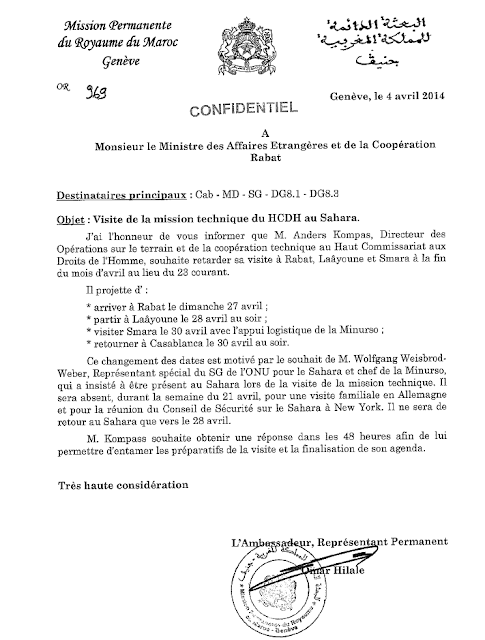
In this document dated April 4, 2014, Omar Hilale informed his minister of the planned visit of a technical mission from the Office of the High Commissioner for Human Rights (OHCHR) to Western Sahara. Anders Kompass, then Director of Field Operations at OHCHR, requested that his visit (initially scheduled for April 23) be postponed until the end of April 2014.
The new schedule proposed an arrival in Rabat on Sunday, April 27, followed by departure for Laayoune on the evening of the 28th, a visit to Smara on the 30th with the support of MINURSO, and a return to Casablanca that same evening. This change was prompted by the desire of Wolfgang Weisbrod-Weber (UN Special Representative and head of MINURSO) to be present during the visit. He had been absent the previous week for family reasons and a Security Council meeting in New York.
The ambassador specifies that Mr. Kompass wishes to receive a response within 48 hours to finalize his agenda and preparations.

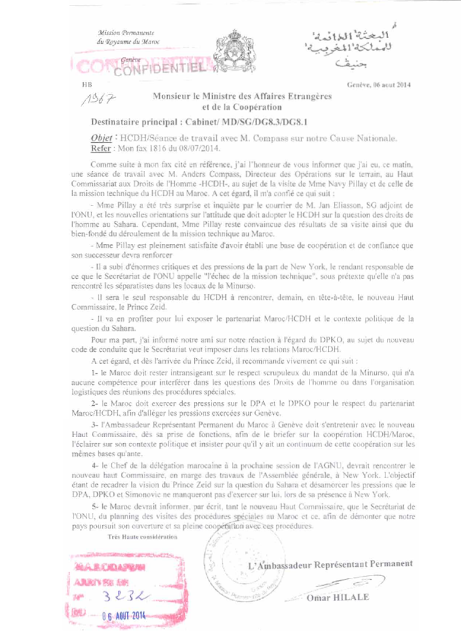
In this document dated August 6, 2014, Anders Kompass informed Omar Hilale that Navi Pillay, the outgoing High Commissioner, had expressed concern about the UN’s new directions regarding human rights in the Sahara, while remaining satisfied with the existing cooperation framework with Morocco.
Kompass confided that he had received significant criticism from the UN Secretariat in New York, which described the technical mission as a « failure » because it did not meet with Sahrawis at the MINURSO headquarters.
Kompass planned to meet alone with the new High Commissioner, Prince Zeid, to outline Morocco’s perspective and the ongoing partnership in order to counter future pressure, remain firm on MINURSO’s mandate, which must not interfere in human rights issues, and exert pressure on the UN departments in New York (DPA and DPKO) to protect the partnership with Geneva.
Kompass is committed to providing Prince Zeid with a swift briefing upon his appointment to ensure continuity of policy under Pillay and to use special procedures visits to demonstrate the country’s willingness to engage with the UN Secretariat.


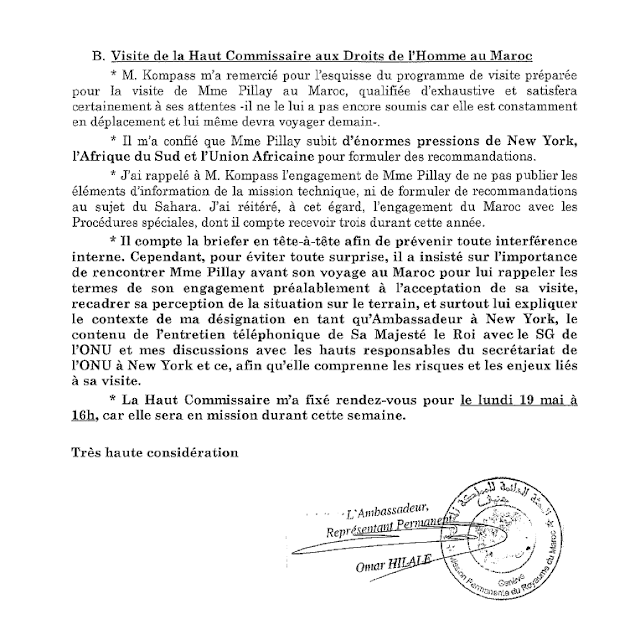
This report, dated May 12, 2014, details a meeting between Ambassador Omar Hilale and Anders Kompass following a technical mission to Western Sahara in May 2014. Kompass describes his discussions with Moroccan authorities as excellent and expresses his admiration for the work of the local branches of the National Human Rights Council (CNDH).
An incident is noted concerning the boycott of meetings by Sahrawi NGOs, as Kompass refused to receive them at the MINURSO offices or at their homes, thus following the Moroccan line, which preferred a meeting at his hotel.
Kompass assures that there will be no official report or recommendations published following this mission. His report to Navi Pillay will be « objective » and will contrast with the more critical perspective favored by UN bodies in New York or by countries like South Africa.
The interview underscores the need to « reframe » the High Commissioner’s image before her trip to Morocco to ensure she respects her commitments not to interfere in the Western Sahara issue.
#WesternSahara #Morocco #Polisario #OHCHR #UNHCR #NaviPillay #AndersKompass #Omar Hilale