


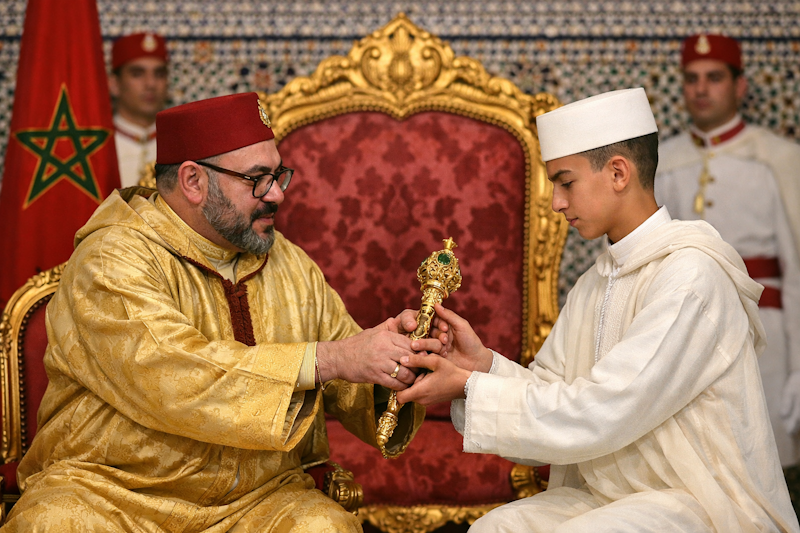
Tags : #Morocco #MohammedVI #crown_prince #Moulay_El_Hassan #succession #Genz212 #Generation_Z
Mohammed VI may live a long life, but a sense of the end of an era has already taken hold in the kingdom. If no unforeseen events occur, he will leave his son, Moulay Hassan, a stable country and an authoritarian regime with numerous diplomatic successes.
Morocco is already living through a phase of end-of-reign. It is not that King Mohammed VI, 62, is gravely ill or that his days are numbered after 26 long years on the throne. Yet dynastic succession has become a topic of conversation in Casablanca’s bourgeois circles, while subtle movements are observed among officials seeking to position themselves more favorably for the arrival of a new king. Although his portrait is everywhere, Mohammed VI has never been very present in the life of his country.
Between long vacations abroad, convalescences, and ailments, the sovereign was the “missing king,” as Britain’s The Economist described him in 2023. He was not even present on Sunday the 21st at the inauguration in Rabat of the Africa Cup of Nations (AFCON), the biggest sporting event in years in Morocco. He began his vacation in Abu Dhabi on November 5, continued it in Paris and Cairo, and was still extending it last weekend, despite official propaganda describing the tournament as the “spark of Morocco’s generalized renaissance.”
He delegated to his son, Moulay Hassan, the task of kicking off the opening match. Perhaps the collective awareness of Mohammed VI’s fragility came in late October 2024, when he went to Rabat airport to welcome French President Emmanuel Macron. He appeared extremely thin, leaning on a cane and walking awkwardly. The official explanation for his use of a walking stick was not very convincing.
When Mohammed VI is gone, Morocco will undergo a smooth transition. The king has an undisputed heir, Moulay Hassan, 22, his only son. Little is known about him, as the royal palace has not even reported on the progress of his studies at UM6P, a private university. In theory, he is less well trained than his father, as he did not pursue a doctorate or complete internships at international organizations. Nor has he been entrusted with many representational duties.
He did welcome Chinese President Xi Jinping in November 2024 during a technical stopover in Casablanca, while the king was again on vacation—an exception. The following month, it was Moulay Rachid, Mohammed VI’s brother, who replaced the monarch at the reopening of Notre Dame Cathedral in Paris, attended by the world’s elite.
Some of the heir’s inclinations have emerged. He is very attached to his mother, Princess Lalla Salma, 47, from whom Mohammed VI separated in March 2018. He lives with her and his sister, Lalla Khadija, 18, in the Dar Es Salam residence; he endured the painful divorce by her side; he vacations with her in Courchevel in the French Alps or in Mykonos in the Aegean Sea.
When he ascends the throne, this information-systems engineer will wield great influence over the new king. When the time comes, Mohammed VI will leave his son—if no unforeseen and undesirable events occur—a well-established kingdom. Despite major social inequalities, Morocco is the most stable country in all of North Africa, more so than Algeria despite its gas and mineral wealth. This is because the monarchy structures the country politically and religiously.
Mohammed VI’s escapades—vacations that stretched to six months in some years; his close friendship with three German-Moroccan mixed-martial-arts fighters with whom he lived in the palace; his staggering with a drink in hand during a Paris night in August 2022—have even trended on social media. They have sparked countless joking or scandalized comments about him but have not eroded the monarchical institution. Not even the major Islamist movement Justice and Charity (Al Adl wal-Ihsan), illegal but sometimes tolerated, seized the opportunity to attack the Commander of the Faithful, the king’s religious title.
Over time, Mohammed VI has become more cautious. After allowing the Azaitar brothers, the MMA fighters, for years to decide who from the royal family could visit him and when, he has now relegated them to the background. They no longer appear at his side or flaunt luxurious gifts—Rolex watches, Ferrari or Bentley cars—on social media.
His main companion since the summer of 2022 has been Yusef Kaddur, 41, a Spaniard from Melilla and also a martial-arts expert. Unlike the Azaitars, he is discreet and modest, but equally ignorant. When he still lived in Melilla, he wrote on Facebook with spelling mistakes. He also lifts the monarch’s spirits when he is downcast. Kaddur enjoys the royal family’s esteem.
The respect—or fear—the king inspires is such that protesters dare not even mention him. The GenZ212 youth movement, which took to the streets in September to demand better education and healthcare, criticized the government led by billionaire Aziz Akhannouch but never targeted the monarch. Many decisions executed by the government are taken in the royal palace.
Today, youth mobilizations, jihadism, political Islam, or the nearly nonexistent left pose no threat to the monarchy or to the courtiers—the makhzen—who gravitate around it. Hence the incomprehensible scale of repression against those who answered the GenZ212 call: 5,780 arrests in the autumn; about 2,480 protesters prosecuted or to be prosecuted; and 1,473 already behind bars, including some 300 minors. These and many other episodes make clear that Morocco is not transitioning toward a parliamentary monarchy.
When Mohammed VI ascended the throne, there were no Moroccan prisoners of conscience—though there were Sahrawis—because his father, Hassan II, loosened his grip at the end of his reign. A quarter century later, many are behind bars, beginning with the four leaders of the peaceful Rif revolt (2016–17) and Mohamed Ziane, 82, Africa’s oldest political prisoner. This former human-rights minister under Hassan II dared suggest in a video that, given the king’s frequent absences, abdication might be preferable. Ziane holds dual Moroccan-Spanish nationality, as his mother was from Málaga.
The winds of freedom began to fade in Morocco after the 2003 Casablanca jihadist attacks (33 dead). They returned briefly during the Arab Spring in early 2011, but another terrorist attack in Marrakech (17 dead) ended the opening. In 2020, after the pandemic, authorities tightened the screws again to silence remaining dissenting voices, starting with leading independent journalists who ended up in prison. They were pardoned in 2024 but cannot practice their profession. Only massive peaceful demonstrations—hundreds of thousands protesting the invasion of Gaza and Morocco’s close ties with Israel—escaped repression. Organized by the Moroccan Front for Solidarity with Palestine and associations quietly backed by Justice and Charity, public outrage was so intense authorities dared not ban them, though they did not reduce cooperation with Israel, now a strategic partner. The Gaza ceasefire brought relief to Moroccan authorities.
“Morocco moved from Hassan II’s dictatorship to Mohammed VI’s enlightened autocracy,” summarized Le Monde in a six-part series published last summer. The autocrat is not alone. He is accompanied by a very small group of collaborators, notably Fouad Ali El Himma, 63, sometimes dubbed the viceroy. A former schoolmate of Mohammed VI at the Royal College in Rabat, El Himma often holds the reins of a country whose head of state disappears at times. He intervenes in all areas, particularly the vast internal-security apparatus headed by Abdellatif Hammouchi, architect of the use of Pegasus spyware. El Himma also oversees foreign policy, implemented by Nasser Bourita, Mohammed VI’s most influential foreign minister.
For the first time this century, cracks have appeared in counterintelligence and the secret police—responsibilities of the DGST under Hammouchi and El Himma’s tutelage. From a mysterious Telegram channel, a hacker group called Jabaroot revealed in August personal data of prominent DGST agents, including properties. Among them was Mohamed Raji, effectively the agency’s number two, nicknamed “Monsieur Wiretaps,” who has led phone surveillance for over 30 years and even received assignments from the king. The flight abroad of Mehdi Hijaoui, former number two of the DGED (foreign intelligence), also signals unrest. Though DGED has fewer staff than DGST, it commands a larger budget. Signs also suggest friction between internal and external intelligence services, without compromising national security.
Where everything has gone smoothly is foreign policy, practically monothematic. Over 100 countries now support Morocco’s brief autonomy plan for Western Sahara proposed in 2007. Two major democracies—the U.S. and France—have gone further by recognizing Moroccan sovereignty over territory the UN still considers non-self-governing. The culmination came on October 31, when the UN Security Council unanimously adopted Resolution 2797, establishing Morocco’s autonomy proposal as the basis for future negotiations—a boost driven by the Trump administration with France’s backing. Israel completes the triumvirate supporting Morocco. “This accumulation of diplomatic victories is all the more striking given that the country’s head of state constitutionally holds almost all power but is frequently absent,” remarked a European official long stationed in Rabat.
This UN backing does not end the Western Sahara dispute, which erupted half a century ago when Spain handed its colony to Morocco and Mauritania. Negotiations will resume, but as long as Algeria supports the Polisario Front, hosting it in its southwest, the conflict will persist at low intensity. Morocco may eventually choose to escalate, risking regional instability. One objective—viewed favorably by Washington—is forcing Western Sahara’s exit from MINURSO, the small UN contingent that has long ceased to fulfill its mission. If that happens, Morocco may exploit its military superiority to seize the eastern strip—20% of the territory—still controlled by Polisario. “With or without an agreement, and with U.S. approval, Morocco will decide when the time is right to annex those areas east of the wall,” predicted Abdelhamid Harifi, administrator of the unofficial Royal Armed Forces–Morocco forum. “It would only take two or three weeks,” he added. How would Algeria react? Would it go to war to protect its protégé?
Western Sahara is not the only arena of rivalry. Moroccan diplomacy exploits Algerian setbacks in the Sahel to advance its pawns. The most striking example is the king’s offer to give Niger, Burkina Faso, and Mali access to the sea via the port under construction in Dakhla, in Western Sahara—an idea that ignores Mauritania and seems far-fetched, like the proposed 6,000-kilometer gas pipeline from Nigeria to Morocco. These projects may not materialize, but in April Mohammed VI posed in Rabat with the foreign ministers of those three countries, once under Algerian influence. Morocco now expands its soft power in parts of the Sahel, even successfully mediating in December 2024 to free four French spies jailed in Burkina Faso.
These achievements unsettle Spain. After the Security Council resolution, Moroccan diplomacy publicly detailed its claims regarding Spain through Atalayar, the unofficial mouthpiece of the Moroccan lobby, and Media24, close to Minister Bourita. “They are emboldened,” Spanish diplomats repeated at year’s end. As Alejandro López Canorea notes in La Guerra del Estrecho, Morocco uses non-military instruments to achieve strategic goals, forming “a kind of hybrid war”—migration being Rabat’s preferred tool, used blatantly in May 2021 when over 10,000 Moroccans entered Ceuta in less than 48 hours. Since Prime Minister Pedro Sánchez’s 2022 letter to Mohammed VI, Moroccan security forces have curbed migration to the Canaries and Andalusia, but not to Ceuta. This effort was the sole tangible quid pro quo for Spain’s alignment with Morocco’s autonomy plan and could be reversed if Rabat seeks more pressure—perhaps postponed by the shared 2030 World Cup project.
Spanish military officials have another concern: Morocco’s alliance with Israel and its technology. “Originally it’s not against us,” said General Miguel Ángel Ballesteros, former head of Spain’s National Security Department, “but we must not forget Morocco’s serious claims over Spanish territory. That alliance worries me.”
When his time comes, the young king must decide whether to keep his father’s collaborators in diplomacy and security. The former succeeded; the latter monitored and curtailed his mother’s movements after the divorce, increasing her suffering. They may not remain. On whom will Moulay Hassan rely? His school and university friends lack experience. By contrast, Commissioner Fouad Boutlaoui, head of the heir’s security, is poised to rise; he harbors resentment toward Hammouchi, who maneuvered to imprison his policeman brother.
Perhaps the best part of Mohammed VI’s legacy will be his fortune, last estimated by Forbes in 2015 at €4.85 billion and likely larger today, given the expansion of the royal holding Al Mada across 24 countries. The worst part will be poverty. The 20-year National Initiative for Human Development, launched in 2005, has had limited success. Still, poverty has declined somewhat. Yet 44% of Moroccans wish to emigrate for better opportunities, especially the young. Behind spectacular infrastructure—Africa’s first high-speed train, Tanger-Med port—lies a less shiny Morocco. In his last Throne Speech in July, Mohammed VI acknowledged this duality: “There is no room, neither today nor tomorrow, for a Morocco that moves at two speeds.”
That should be Moulay Hassan’s great task: achieving balanced growth that brings Morocco closer to southern Europe’s living standards. Morocco’s per-capita income (€4,240 in 2025) is seven times lower than Spain’s. Spain has 10 million more inhabitants, yet its GDP is ten times larger. Morocco’s entire wealth equals that of a single Spanish autonomous community—Valencia.
El Confidencial, 31/12/2025