Tags : #United_Nations #UNO #Morocco #Ramtane_Lamamra #Ban_Ki_moon #Western_Sahara #Sahel #Mali #Libya #espionage #Morocco_Leaks #Marocleaks
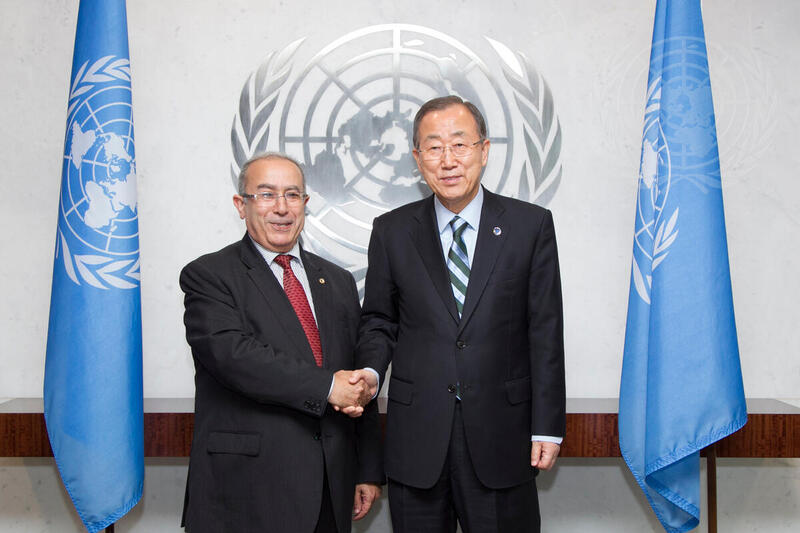
Hacker Chris Coleman leaked a confidential document regarding Morocco’s involvement in espionage activities targeting the UN Secretariat and the UN mission in Western Sahara (MINURSO). Here is the report of the meeting between the head of Algerian diplomacy and UN Secretary-General Ban Ki-moon. Here is the its full text:

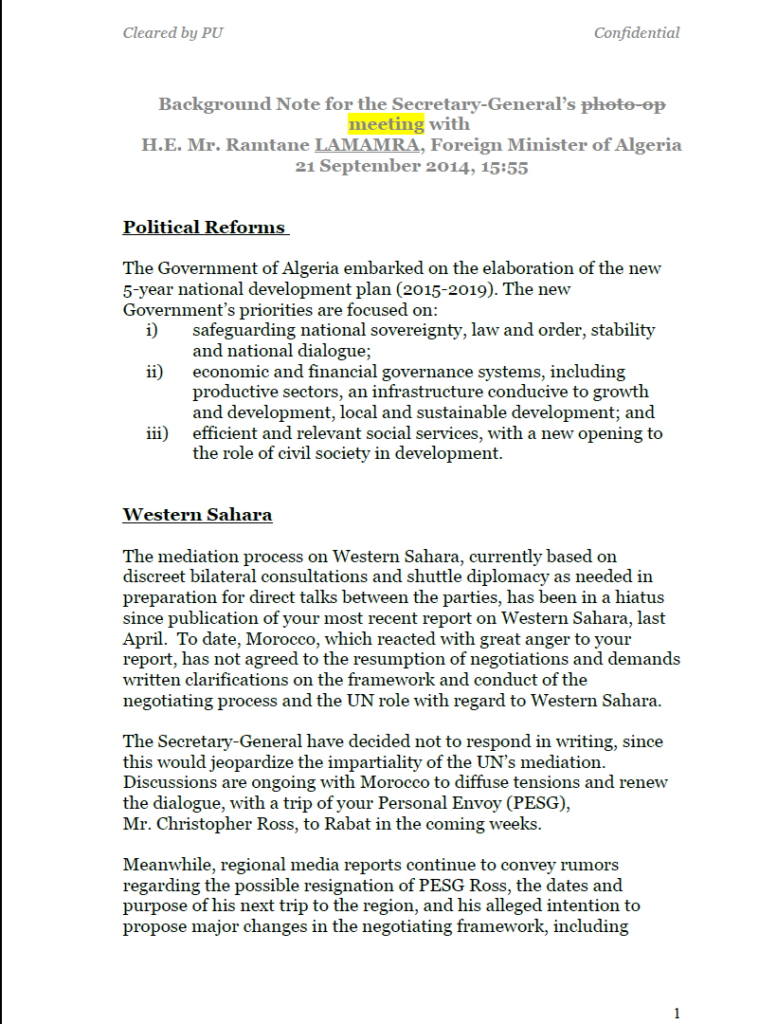
Algeria – Background Note (17 September 2014)
Cleared by PU Confidential Background Note for the Secretary-General’s photo-op meeting with H.E. Mr. Ramtane LAMAMRA, Foreign Minister of Algeria 21 September 2014, 15:55
Political Reforms
The Government of Algeria embarked on the elaboration of the new 5-year national development plan (2015-2019). The new Government’s priorities are focused on:
- i) safeguarding national sovereignty, law and order, stability and national dialogue;
- ii) economic and financial governance systems, including productive sectors, an infrastructure conducive to growth and development, local and sustainable development;
- iii) and efficient and relevant social services, with a new opening to the role of civil society in development.
Western Sahara
The mediation process on Western Sahara, currently based on discreet bilateral consultations and shuttle diplomacy as needed in preparation for direct talks between the parties, has been in a hiatus since publication of your most recent report on Western Sahara, last April. To date, Morocco, which reacted with great anger to your report, has not agreed to the resumption of negotiations and demands written clarifications on the framework and conduct of the negotiating process and the UN role with regard to Western Sahara.
The Secretary-General have decided not to respond in writing, since this would jeopardize the impartiality of the UN’s mediation. Discussions are ongoing with Morocco to diffuse tensions and renew the dialogue, with a trip of your Personal Envoy (PESG), Mr. Christopher Ross, to Rabat in the coming weeks.
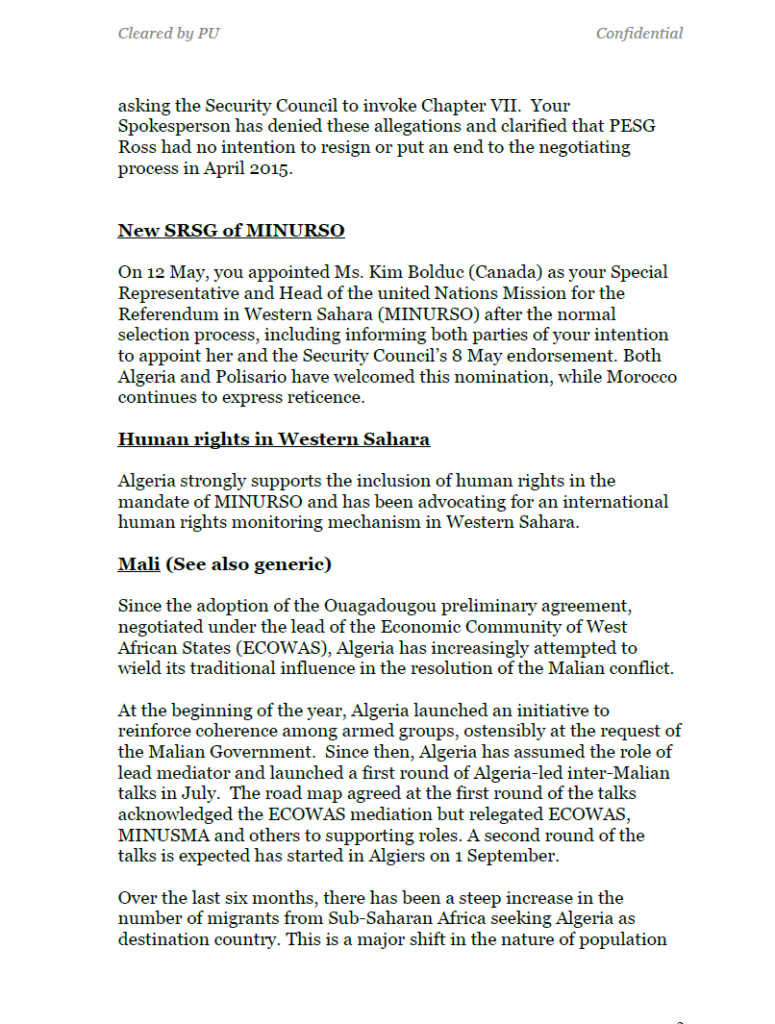
Meanwhile, regional media reports continue to convey rumors regarding the possible resignation of PESG Ross, the dates and purpose of his next trip to the region, and his alleged intention to propose major changes in the negotiating framework, including asking the Security Council to invoke Chapter VII. Your Spokesperson has denied these allegations and clarified that PESG Ross had no intention to resign or put an end to the negotiating process in April 2015.
New SRSG of MINURSO
On 12 May, you appointed Ms. Kim Bolduc (Canada) as your Special Representative and Head of the united Nations Mission for the Referendum in Western Sahara (MINURSO) after the normal selection process, including informing both parties of your intention to appoint her and the Security Council’s 8 May endorsement. Both Algeria and Polisario have welcomed this nomination, while Morocco continues to express reticence.
Human rights in Western Sahara
Algeria strongly supports the inclusion of human rights in the mandate of MINURSO and has been advocating for an international human rights monitoring mechanism in Western Sahara.
Mali (See also generic)
Since the adoption of the Ouagadougou preliminary agreement, negotiated under the lead of the Economic Community of West African States (ECOWAS), Algeria has increasingly attempted to wield its traditional influence in the resolution of the Malian conflict. At the beginning of the year, Algeria launched an initiative to reinforce coherence among armed groups, ostensibly at the request of the Malian Government. Since then, Algeria has assumed the role of lead mediator and launched a first round of Algeria-led inter-Malian talks in July.
The road map agreed at the first round of the talks acknowledged the ECOWAS mediation but relegated ECOWAS, MINUSMA and others to supporting roles. A second round of the talks is expected has started in Algiers on 1 September.
Over the last six months, there has been a steep increase in the number of migrants from Sub-Saharan Africa seeking Algeria as destination country. This is a major shift in the nature of population movement not transiting but staying in the northern cities. Algeria seems to be ready to support these migrants (approximately 25,000 people), but currently there is no national strategy for this new phenomenon. The UN has offered assistance but is waiting for an official response from the government.
Libya
Algeria is greatly concerned about cross-border trafficking in weapons and the safe haven that the Libyan desert provides to extremist groups. While they supported Mr. Qadhafi, bilateral relations have improved since the Revolution. However, Algeria still views Libya, and in particular the security situation, with great concern, which has been exacerbated by the recent fighting between Islamist and non-Islamist factions.
On 16 May, Algerian Special Forces reportedly evacuated the Ambassador and Embassy staff from Tripoli in response to an « imminent and direct threat ». Algeria fears being associated with the fighting currently taking place. On 19 May, Sonatrach, the Algerian State energy company, evacuated some 50 workers from Libya over security concerns. Algiers has also increased security along its border with Libya and imposed additional restrictions on crossing points.
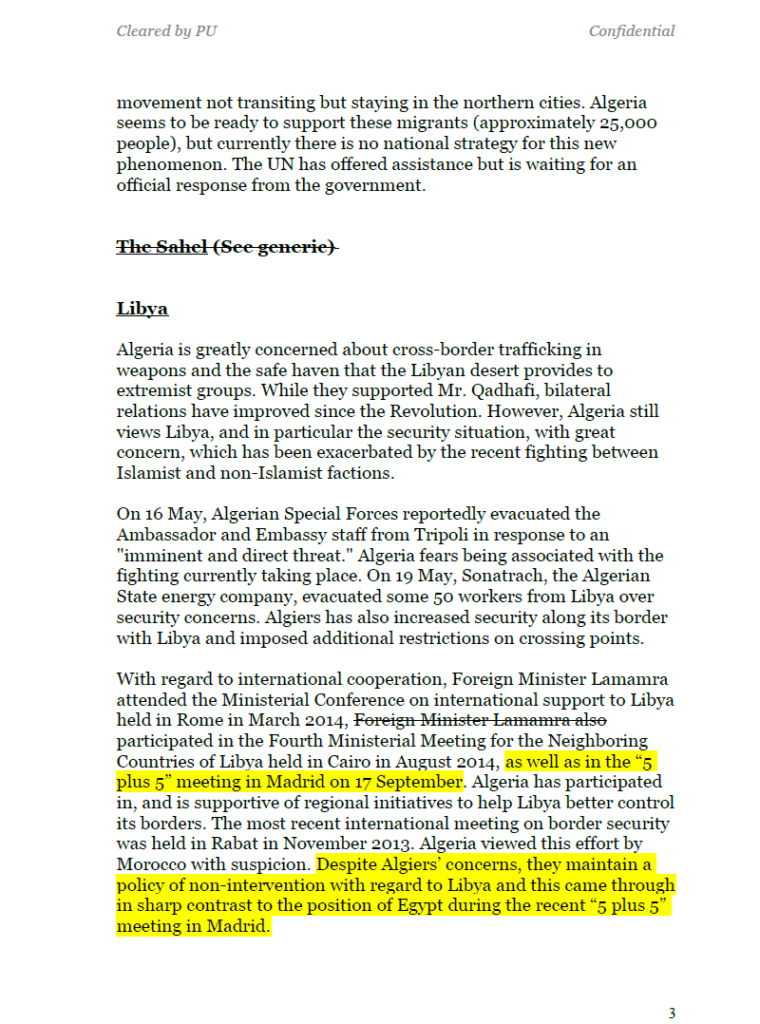
With regard to international cooperation, Foreign Minister Lamamra attended the Ministerial Conference on international support to Libya held in Rome in March 2014, Foreign Minister Lamamra also participated in the Fourth Ministerial Meeting for the Neighboring Countries of Libya held in Cairo in August 2014, as well as in the « 5 plus 5 » meeting in Madrid on 17 September. Algeria has participated in, and is supportive of regional initiatives to help Libya better control its borders. The most recent international meeting on border security was held in Rabat in November 2013. Algeria viewed this effort by Morocco with suspicion. Despite Algiers’ concerns, they maintain a policy of non-intervention with regard to Libya and this came through in sharp contrast to the position of Egypt during the recent « 5 plus 5 » meeting in Madrid.
Moroccan-Algerian relations
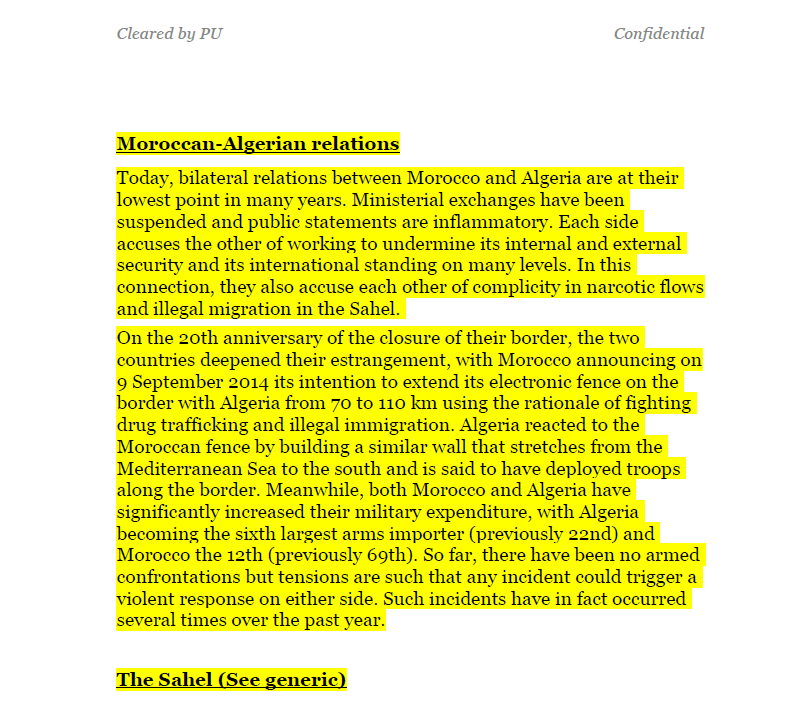
Today, bilateral relations between Morocco and Algeria are at their lowest point in many years. Ministerial exchanges have been suspended and public statements are inflammatory. Each side accuses the other of working to undermine its internal and external security and its international standing on many levels. In this connection, they also accuse each other of complicity in narcotic flows and illegal migration in the Sahel.
On the 20th anniversary of the closure of their border, the two countries deepened their estrangement, with Morocco announcing on 9 September 2014 its intention to extend its electronic fence on the border with Algeria from 70 to 110 km using the rationale of fighting drug trafficking and illegal immigration. Algeria reacted to the Moroccan fence by building a similar wall that stretches from the Mediterranean Sea to the south and is said to have deployed troops along the border.
Meanwhile, both Morocco and Algeria have significantly increased their military expenditure, with Algeria becoming the sixth largest arms importer (previously 22nd) and Morocco the 12th (previously 69th). So far, there have been no armed confrontations but tensions are such that any incident could trigger a violent response on either side. Such incidents have in fact occurred several times over the past year.
The Sahel (See generic)
في يوليو 2014، وافقت تشاد على استضافة قواعد الحملة العسكرية الفرنسية « لمكافحة الإرهاب » في الساحل (« عملية برخان ») في نجامينا.