
Tags: Morocco, Western Sahara, Marocleaks, United Kingdom, Independent Diplomat
According to an internal note from the Moroccan Ministry of Foreign Affairs, the Western Sahara issue « remains a subject of permanent misunderstanding » with the United Kingdom.
For Rabat, « the United Kingdom maintains its dichotomous vision » of the Western Sahara issue « and continues to separate the political aspect (negotiation process, autonomy plan) from what is perceived as the « technical aspect » (human rights, natural resources, challenges of MINURSO). »
Full text of the note
The United Kingdom and the Question of the Moroccan Sahara
Despite recent developments in relations between Morocco and the United Kingdom, the Western Sahara issue remains a persistent source of misunderstanding. London’s position on this matter remains disconnected from the positive developments observed bilaterally.
Indeed, the United Kingdom maintains its dichotomous view of the National Question and continues to separate the political aspect (negotiation process, autonomy plan) from what is perceived as the « technical aspect » (human rights, natural resources, challenges of MINURSO).
I- Manifestations of hostility from the United Kingdom:
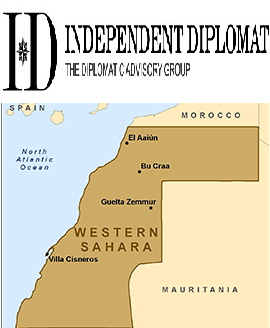
– London has become the centre of pro-Polisario lobbying, notably through the NGO “Independent Diplomat”;
– For the past four years, London has been the main instigator of amendments hostile to Morocco during the drafting and negotiation of Security Council resolutions on the Moroccan Sahara;
– The role of the British is becoming increasingly dangerous as they are known for their mastery of UN mechanisms (drafting resolutions, searching for insidious formulas), which has allowed them to play the bad guy during the negotiations of resolutions on the Sahara, either in a voluntary manner or as part of a sharing of roles with the United States of America.
– The British Government notably abstained during the European Council vote on the renewal of the Additional Protocol to the Morocco-EU Fisheries Agreement and presented a policy paper unfavorable to its MEPs, who voted overwhelmingly in plenary session. However, the United Kingdom gave its unconditional support to the Morocco-EU Agricultural Agreement and more recently, Mr. William Hague issued a very positive statement welcoming the launch of Morocco-EU negotiations for a Deep and Comprehensive Free Trade Agreement;
– The recurring questions from certain British MPs openly supporting the Polisario’s position. It should be noted that the number of questions asked about our country has gradually decreased over the last three years: 96 questions in 2012, compared to 67 in 2010 and 30 in 2011. During the first quarter of 2013, 18 questions have been submitted so far, all concerning the National Question;
– The mobilization of British petitioners against Morocco’s position during the debates of the 4th Committee of the UN General Assembly on the question of the Moroccan Sahara;
– In several respects, the British position aligns with that of Algeria and the Polisario Front (referendum as a means of self-determination, expansion of the MINURSO mandate and illegality of the exploitation of natural resources);
– The still circumspect position towards the Moroccan Autonomy Initiative.
II- The « justifications » for these displays of hostility:
1) The United Kingdom considers, for ideological reasons, that self-determination is equivalent to a referendum, based on their doctrine applied to the cases of the Falkland Islands and Gibraltar. These ideological considerations are more relevant than ever in the context of the ongoing campaigns for the self-determination referendums in the Falkland Islands (10-11 March 2013) and in Scotland (last quarter of 2014);
2) This country, in its capacity as a permanent member of the UN Security Council, projects its power through its activism on the technical aspect of the National Question in order to better position itself on the Maghreb chessboard, although London considers that these are positions of principle, in accordance with international commitments and without political aim;
3) London’s strategic interests in its relations with Algeria;
4) This country’s doctrine at the UN concerning peacekeeping operations (Franco-British initiative on the establishment of guidelines for the implementation of the mandates of the various peacekeeping operations);
5) The rising pressures from the « human rights » lobby in London (Amnesty International, Land Mine Action, Independent Diplomat etc);
Beyond these justifications, British diplomatic action is often based on the following pyramid structure:
Strategic interests: Activism to achieve the partner’s objectives (case of South Sudan and Ethiopia)Growing interests: Adaptation of principles to the partner’s interests (case of Algeria)Lack of interest: Management according to principles (case of Morocco)
According to this framework, London’s attitude towards Morocco’s position is at the base of the pyramid. Indeed, the United Kingdom discusses matters of principle with Morocco, given our failure to establish common interests despite all the efforts undertaken by our country in recent years.
Strategic dialogue offers us an opportunity to structure these interests, enrich their content and develop their modalities.
III- British attitudes at the April 2013 deadline:
London should focus on the challenges facing MINURSO, natural resources and human rights.
Regarding the challenges facing MINURSO, the United Kingdom, which has focused its efforts on human rights since 2012, raised the issue of challenges to suggest that MINURSO does not operate with complete freedom and that it should be strengthened to align with the practices of other peacekeeping missions. The challenges specifically cover three aspects: plaques, flags, and interaction with interlocutors.
1- License plates: The United Kingdom supports MINURSO’s request to entrust it with the entire vehicle registration process
Morocco has submitted an offer to issue a limited number of separate license plates (two or three) on the condition that the vehicle registration process is carried out within the framework of the national procedure in force (issuance of registration certificates, insurance etc);
2- Moroccan flags: MINURSO wants Morocco to remove the 17 flags around its headquarters in Laayoune. Our country is in discussions with MINURSO on this matter. A solution is being finalized.
3- The interlocutors: It would be appropriate to explain Morocco’s efforts to promote MINURSO’s interaction with the usual interlocutors (Coordination Office and institutional bodies).
Regarding the issue of natural resources: Under the impetus of « Independent Diplomat », attacks are directed against Morocco’s agreements with the EU and a mobilization against companies operating in the Sahara.
Regarding human rights: A small change has been noted in the interest shown by the British in the work of the CNDH, particularly in the southern provinces.
#WesternSahara #UnitedKingdom #Morocco #Polisario #IndependentDiplomat