Tags : Western Sahara, Polisario Front, Morocco, UN Security Council, United States, China, Russia, Resolution 2797 (2025), Gaza, Palestine, Israel,
According to Just Security, the United Nations Security Council, the very body created to protect state sovereignty, is undergoing a radical transformation. Led by a tacit entente of the three nuclear superpowers—the United States, China, and Russia—it is shifting from a guardian of international law into a manager of spheres of influence, using its authority to legitimize the conquest and partition of territories.
The Catalyst: Two Revealing Resolutions
The article hinges on two recent UNSC resolutions that exemplify this dangerous shift:
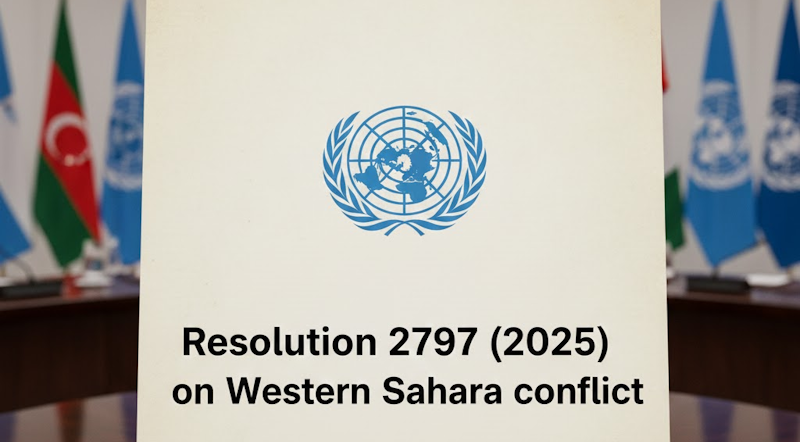
- Resolution 2797 (Oct. 31): Concerning Western Sahara, it formally endorsed Morocco’s 2007 Autonomy Plan as the basis for a solution, treating the territory as autonomously under Moroccan sovereignty and negating the Sahrawi people’s right to an independent state. This directly contradicts a decades-long international legal consensus, including International Court of Justice (ICJ) opinions, that Western Sahara is a non-self-governing territory whose people have the right to self-determination, and that Morocco is an illegal occupier.
- Resolution 2803 (Nov. 17): Concerning Gaza, it outlined a « credible pathway » to Palestinian statehood but subjected it to a protracted, conditional process overseen by a U.S.-led board, effectively indefinitely delaying sovereignty for a widely recognized people.
A Historical and Legal Betrayal
The piece details the long history of the Western Sahara conflict, underscoring the magnitude of the reversal:
- The ICJ affirmed the Sahrawi right to self-determination in 1975.
- The UN has long listed it as a non-self-governing territory and established a mission (MINURSO) to organize an independence referendum, which never occurred.
- Courts like the African Court on Human and Peoples’ Rights and the Court of Justice of the European Union have affirmed the obligation to uphold Sahrawi rights.
Despite this, since 2020, major powers—including the U.S., key EU states (France, Spain, Germany, the UK), and Israel—have unilaterally recognized or acquiesced to Morocco’s sovereignty, driven by geopolitical interests (migration control, trade, the Abraham Accords). Resolution 2797 codifies this fait accompli at the UN.
The Larger Danger: A New « Tripartite Entente » and the End of Sovereign Equality
The article argues these are not isolated incidents but symptoms of a systemic collapse:
- The New « Rules-Based Order »: The U.S., China, and Russia, while rivals, are converging in using the Security Council to ratify spheres of influence and annexations, granting them a veneer of legality. They achieve this by securing the votes of smaller, dependent states through promises of arms, trade deals, or security.
- Corrosion of Foundational Norms: This process deliberately undermines the peremptory (highest-order) norms of self-determination, sovereignty, and territorial integrity—the very principles middle and smaller powers rely on for their own security.
- A Chilling Historical Parallel: The author draws a stark comparison not just to the failed League of Nations, but to the 1884-85 Berlin Conference, where colonial powers carved up Africa. The reference to a « Board of Peace » chaired by a U.S. president evokes the personal sovereignty granted to King Leopold II over the Congo.
The Conundrum and a Faint Hope
The situation creates impossible dilemmas:
- Legal Conundrum: States are now torn between obeying binding UNSC resolutions and upholding the higher jus cogens norms those resolutions violate.
- Institutional Conundrum: The UN itself risks becoming a tool for legitimizing protectorates rather than a trustee of international law.
The only bulwark, the article concludes, is the collective action of middle powers (states like Brazil, South Africa, Indonesia, and European nations outside the P3). They have the voting power in the Security Council and the greatest existential interest in defending the sovereignty system. The warning from Algeria’s ambassador is quoted as a crucial rallying cry: if this framework of imposed « autonomy » is accepted in Western Sahara, it will be replicated for other peoples, from Ukraine to Taiwan, dismantling the international order entirely.
In essence, the article sounds a major alarm: the world is sliding back toward a system where great powers, operating through a repurposed UN, formally divide the world into zones of control, sacrificing the sovereign rights of smaller peoples on the altar of geopolitical pragmatism.
#WesternSahara #Polisario #Morocco #UN #SecurityCouncil #Resolution2797(2025)