


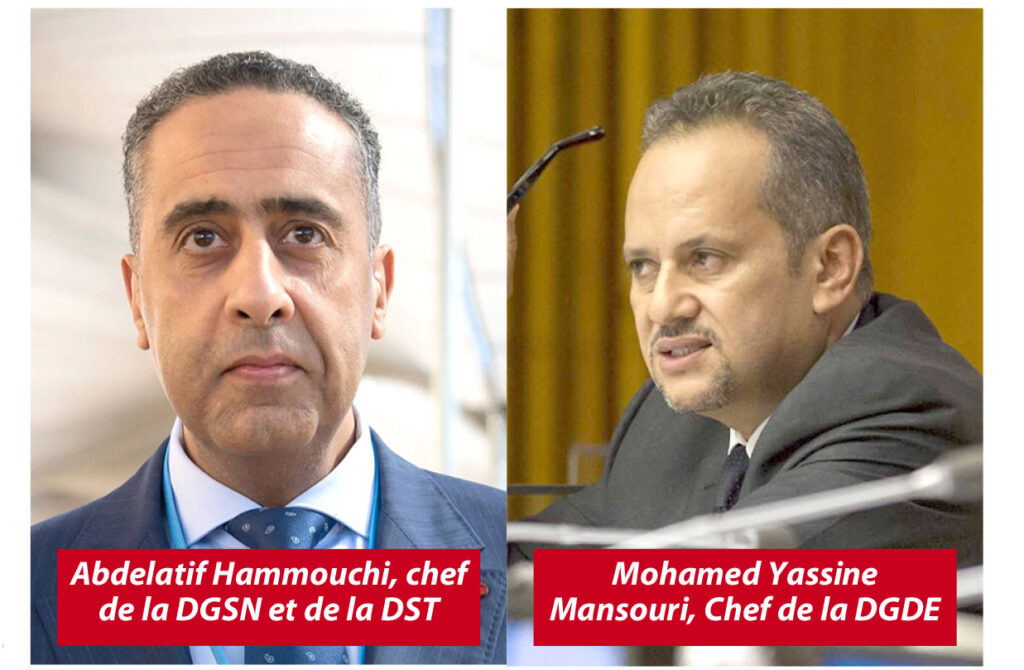
A hidden war between powerful wings of the state has erupted into the open in Morocco, according to journalist and former Moroccan diplomat, Ali Lamrabet, who pointed to an authoritarian drift within the Moroccan security apparatus centered around the figure of intelligence chief Abdellatif Hammouchi.
Ali Lamrabet wrote in a social media post: “A hidden war between powerful wings of the state is surfacing in Morocco, revealing that Commissioner Abdellatif Hammouchi, the supreme head of the General Directorate of National Security (the regular police) and the Directorate of Territorial Surveillance (the political police), acts as he pleases.”
Discussing the behind-the-scenes of a sensational case that exposes authoritarian abuses and rivalries within the Moroccan security apparatus, he explained that Hammouchi “used a site funded by secret money and linked to the DST, +Barlamane.com+, to attack his great rival in the DGED (the external intelligence service) and several of its officials, including the Director General.”
Ali Lamrabet also revealed how a “trivial case concerning an exploitation license,” obtained “in the most legal way possible,” was turned into a terrorism case without any evidence being presented.
In an attempt to target the former number two of the DGED, Mehdi Hijaouy, who fled abroad, “Hammouchi deployed the National Brigade of Judicial Police, an elite unit that usually handles only major judicial cases.”
He added: “The BNPJ then shut down a spa in Rabat belonging to Hijaouy’s wife, arrested the top official responsible for issuing commercial exploitation licenses at city hall, along with a batch of ordinary citizens, and quickly brought them before a court specialized in terrorism cases,” noting that the defendants’ lawyer was “stunned” when learning of the charges, wondering how a simple license issue could be judged by such a jurisdiction.
Quoting a witness, he stated that “the magistrates of this terrorism court, themselves trained in the DST school, were astounded, even paralyzed.”
The journalist and former diplomat revealed another abuse, noting that “Barlamane.com, the faithful watchdog of the DST, insinuated that even the supervising minister of both the DGSN and DST, Interior Minister Abdelouafi Laftit, was part of a conspiracy against the state.”
This insinuation, “repeated twice,” represents a major escalation and a break in Morocco’s constitutional chain of command.
Ali Lamrabet stressed that “in high circles, it is said that within the army and the Royal Gendarmerie, brows are being furrowed and concern is growing over Hammouchi’s dangerous drift.”
Thus, the DST/DGED conflict reveals deep fractures within the Moroccan security apparatus.
The use of disproportionate means (the BNPJ and an anti-terrorism court for an administrative case) testifies to the intensity of these rivalries.
Escape of the Second-in-Command of Moroccan Intelligence
The Spanish newspaper La Razón revealed that Moroccan security services monitored the second-in-command of Morocco’s foreign intelligence agency, Mehdi El Hijaouy, during his stay in Madrid, without the knowledge of the Spanish Ministry of Interior. The matter ended with him fleeing Spain along with his family, with the paper stressing that their lives are in danger and their whereabouts remain a mystery.
The Spanish daily reported on Friday the details of the escape of Mehdi El Hijaouy, the number two in Morocco’s foreign intelligence, and his defection from the kingdom’s security apparatus after entering Spanish territory. It explained that “El Hijaouy’s life took a drastic turn when he uncovered a corruption case and reported it to King Mohammed VI. The authorities reviewed all the documents he presented, but they were deemed insufficient and ordered his arrest, which led him to suddenly flee the country where he had worked for more than two decades.”
He initially settled in France with his wife and their infant son, who was only a few months old. But soon, the family was subjected to turmoil. The source noted that “Mehdi’s wife would go out into the street pushing the stroller of their baby, while Moroccan intelligence agents constantly trailed her. She could recognize the faces of those individuals, whom, according to her husband, worked at the Moroccan embassy. Fearing for her safety, she reported the surveillance to Paris police on September 10 at 3:38 p.m., telling officers: they neither spoke to me nor touched me.”
Due to this “tight surveillance,” the family decided to move again, this time to Madrid. They settled in an apartment on Jorge Juan Street, which El Hejjawi was paying for, since his two sons (from his first marriage), aged 25 and 20, were living there.
In September of the same year (2024), Spain’s national police arrested El Hijaouy under an active Moroccan arrest warrant. He testified before Madrid’s Court of First Instance No. 1, strongly opposing his extradition. In his statement, he declared that he had worked for 24 years in Moroccan secret police and had written to King Mohammed VI to warn him about the corruption of his close associates.
El Hijaouy confirmed that he had previously reported threats in Paris and that he was being persecuted. According to him, he had only been in Spain for three days, arriving with a friend who later left Madrid, and his sole purpose was to see his children, for whom he was paying €4,500 per month in rent. He also mentioned having another son living in Dubai.
In his testimony, he requested political asylum in Spain, justifying it by saying his income came from online security courses he provided. The prosecutor’s office requested his release but asked him to provide documentation supporting his claims.
The Spanish paper continued: “From that moment, El Hejjawi’s ordeal in Spain began, as Moroccan security forces surrounded the home where he and his family lived in central Madrid. When the pressure reached its peak and they once again feared for their lives, El Hijaouy contacted Spanish national intelligence to provide evidence of his persecution—even though the Ministry of Interior had no knowledge of these espionage activities on Spanish soil.”
After his release, El Hijaouy was scheduled to appear before the National Court on November 7, but his hearing was postponed to the 21st of the same month. He failed to attend either date, and the court waited all morning for him. For that reason, on November 26, 2024, the court issued a search and arrest warrant against him. Spanish police went to his residence to check if he was there, but no one opened the door. Two months later, the whereabouts of Mehdi El Hijaouy and his family remain an enigma.
According to consulted sources, his disappearance is the key to his survival. At many points during his stay in Spain, El Hijaouy feared for his life and that of his relatives. He was able to identify the spies following him, since he himself had been in command of Moroccan intelligence.
The Spanish newspaper described El Hijaouy, who was born in Germany, as a “spymaster,” noting that he has extensive security training and is considered one of Morocco’s most knowledgeable security experts. One of his last positions was head of security for the Moroccan national football team during the 2022 World Cup in Qatar.