


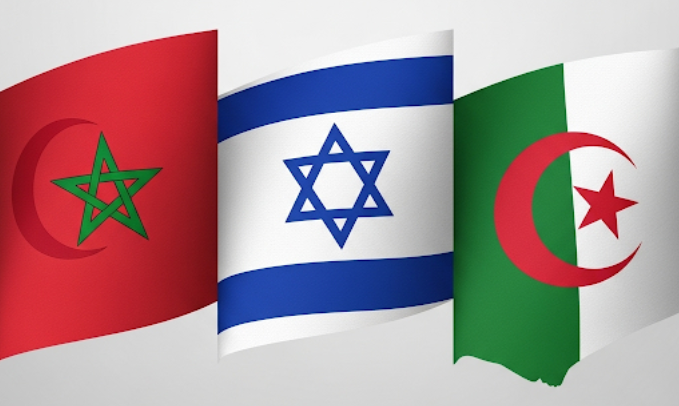
Tags : Western Sahara, Morocco, Polisario Front, Algeria, lobbying, zionism, United States,
By Nassim Mecheri
For several years, Morocco has been waging a relentless war against Algeria, often through intermediaries and generously funded networks. This dirty war—fought on diplomatic, media, and ideological fronts—was already exposed by WikiLeaks cables. It is based on a clear strategy: weaken Algeria on the international stage, tarnish its image, and isolate it over the Western Sahara issue.
To achieve this, the Makhzen has relied on powerful Zionist lobbies in the United States—especially within Congress and AIPAC, the main pro-Israel lobby, which is now aligned with Morocco’s cause. The most recent development in this proven scheme is the hiring of the staunchly pro-Zionist Republican Congressman Joe Wilson from South Carolina, and his Democratic colleague Jimmy Panetta, a former U.S. intelligence officer. These two lawmakers are pushing for legislation that would label the Polisario Front as a “terrorist organization supported by Iran, Hezbollah, and Russia.” A ridiculous claim that collapses under scrutiny.
The Polisario is officially recognized by international organizations, including the UN, as the legitimate representative of the Sahrawi people. It co-signed the 1991 ceasefire with Morocco, the 1996 Houston Agreements, and has been part of the Manhasset talks since 2007. Neither the U.S. administration nor the CIA has ever reported any link between the Polisario and Iran. More telling are the comments of John Bolton, former White House advisor and U.S. ambassador to the UN, who is well-versed in the workings of Congress and Zionist lobbies. In a recent interview with Spanish daily El Independiente, Bolton stated that many American NGOs work in Sahrawi refugee camps and have never reported any Iranian, Hezbollah, or related influence. “There is simply no basis for this. It’s pure propaganda,” Bolton said.
It is well known that since normalizing relations with Tel Aviv in 2020, Morocco has steered its foreign policy toward strategic alignment with Israel—at the expense of international law principles—in exchange for Western diplomatic support. According to many observers, this is a collusion between two of the most criticized colonial powers on the global stage. This partnership goes well beyond economic and security cooperation.
The Schemes of the Pasha’s Son
This agenda is part of a structured plan designed with Israeli experts tasked with advising Moroccan authorities on regional affairs, with the sole aim of harming Algeria by all means. Omar Hilale, Morocco’s permanent representative to the UN, has spearheaded the defamation campaign against Algeria within UN institutions since 2006. This son of a pro-French Pasha from colonial times allegedly tried—according to WikiLeaks—to link Algeria to terrorism, without success.
The United States and other Security Council powers have frequently praised Algeria’s counterterrorism efforts. President Barack Obama’s statement after the 2013 Tiguentourine terrorist attack was a stinging rebuttal to Algeria’s critics.
Furthermore, Rabat thought it had scored a decisive victory in December 2020, when Donald Trump—desperate to reverse the election outcome—recognized Moroccan sovereignty over Western Sahara in exchange for Morocco’s normalization with Israel. Trump, rejecting the election results, was trying to win over Zionist lobbies. But since his re-election in November 2024, the outlook is less favorable to the Makhzen. The Trump administration has maintained the need for a “mutually acceptable solution” to the Sahrawi conflict, thereby acknowledging the legitimacy of the Polisario—unlike the political stunts by Wilson and Panetta.
In light of this new context, Rabat is working to reduce the mandate of the UN mission in Western Sahara (MINURSO), effectively neutralizing it and framing the conflict as a “purely Moroccan issue.” The goal is to strip the conflict of its international dimension.
As part of this strategy, Morocco attacks Algeria for supporting the Sahrawi people’s just cause, pushing a narrative that Algeria is close to Iran or Russia, and mobilizing French media to echo Makhzen propaganda without critical analysis.
Recently, Morocco has aimed to build a coalition around its position. An international conference is being prepared in Dubai, bringing together countries that have recognized or supported the Moroccan autonomy plan. The clear objective is to create a pro-Moroccan front to marginalize the Polisario Front and silence Algeria, which firmly supports international legality and the right of peoples to self-determination.
However, Algeria continues to follow its steady course, according to President Abdelmadjid Tebboune, countering Morocco’s Machiavellian offensive with a strategy rooted in consistency, credibility, and alliance-building—both with historical and new partners. Guided by respect for international law, Algeria refuses to deviate from this legitimate framework, rejecting a world order based on brute force—a scenario embraced in Rabat and by its Zionist partner, but firmly rejected in Algiers.
Le Jeune Indépendant, July 8, 2025